放射性物質で汚染された資材が国を超えて流通した「アメリカ大陸最大の被ばく事故」の原因とは? via Gigazine

原子力発電に関連する事故といえばチェルノブイリ原子力発電所事故が有名ですが、人が被ばくするのは必ずしも原子力発電に伴う事故とは限りません。過去には、博物館に放射線を放つ鉱石がバケツに入ったまま放置されていた事例や、放射能が残留する遺体を処理した火葬場職員が被ばくする事例も報告されていますが、中でもアメリカ大陸最大の被ばく事故とされるのが「シウダー・フアレスコバルト60汚染事故」です。

The Mexican Chernobyl, The Biggest Nuclear Accident In The American Continent – What’s on
https://culturacolectiva.com/history/cobalt-60-ciudad-juarez-mexico-nuclear-accident

アメリカとメキシコにまたがる広域を放射能で汚染する事故が起きたのは、アメリカとの国境沿いに位置するメキシコのシウダー・フアレスという都市でした。1983年12月6日、シウダー・フアレスの医療センターに務める保守作業員のVicente Sotelo氏とRicardo Hernández氏は、「病院の倉庫にあるものを好きに持って帰っていい」と告げられ、ガラクタの中から転売できそうなものを物色していました。

(略)

金属のスクラップとして放射線治療装置を売ることにした2人は、ハンマーなどで機械を分解する中で100kgもある箱形の部品があることに気づきました。2人が箱を壊すと、その内部には小さな球形の粒(ペレット)が6000個以上も納められていましたが、気にせず分解した機械をピックアップトラックにのせたそうです。

実はこのペレットの材料は、放射線治療装置において放射線源として用いられていたコバルト60であり、大量の放射線を出していました。しかし、2人はそれに気づかないままトラックでリサイクル場まで運び、トラックの内部だけでなく道ばたにも大量のペレットをばらまいたとのこと。

(略)

2人が機械の部品をリサイクル場に売りつけると、Sotelo氏は放射性物質で汚染されたピックアップトラックを家の近くに駐車。ピックアップトラックはその直後にバッテリーが盗まれたそうで、そのまま3カ月ほど人口密度が高い地域に放置されました。

リサイクル場では、クレーンや付近の金属くずが放射線を出す機械の部品や微少なペレットに汚染されたほか、機械の金属部品は提携する精錬業者に運び込まれました。精錬業者は金属くずを解かして建築資材やテーブルなどに利用する金属ブロックに加工しており、機械の部品や二次汚染された金属くずを含んだ資材が推定2万トンも製造されたとのこと。そして2人が放射線治療装置を売り飛ばした翌月には、誰も知らないうちに放射性物質で汚染された資材がメキシコ国内だけでなくアメリカにも搬出されてしまったそうです。

(略)

この手がかりをもとに捜索したところ、このトラックがモーテルの前に駐車されているのが発見され、当局が事態の収拾に乗り出しました。トラックからは1時間当たりでおよそ1000レム(10シーベルト)もの放射線が検出されたそうで、これはレントゲン撮影機が放射する放射線(0.2レム)の5000倍であり、50%の被ばく者が死亡するとされる400レムの被ばく線量を大幅に上回る値です。

メキシコ原子力安全・保障措置委員会(CNSNS)などの調査によって、アメリカとメキシコの国境沿いに汚染された金属が広まっていることが判明したため、当局は汚染物質の回収を開始。アメリカの当局は国内に流通していた1000トンの汚染物質のうち90%を回収してメキシコに送り返しましたが、メキシコでは1万9000トンのうち5000トンしか回収できなかったとのこと。

また、最初にSotelo氏とHernández氏が放射線治療装置を運んだ際にばらまかれた放射線源のペレットを回収するため、180人もの労働者が動員されたそうですが、労働者には満足な保護具も与えられなかったそうです。この事故に関連して被ばくした人々の総数は、4000人に上るとみられています。

放射線の被ばくは人々にさまざまな健康上の問題をもたらす可能性がありますが、かなりの線量を浴びたはずのSotelo氏には深刻な症状が現れなかったそうで、「Vicente the Bionic Man(超人のビセンテ)」というあだ名で呼ばれました。一方、汚染が広がったシウダー・フアレスの町では、事故後の数年間でがん患者の増加や奇形で生まれたり死産したりする子どもの数が増加が確認されたとのことです。

全文は放射性物質で汚染された資材が国を超えて流通した「アメリカ大陸最大の被ばく事故」の原因とは?

Posted in *日本語 | Tagged , , , | 7 Comments

Plutonium: How Nuclear Power’s Dream Fuel Became a Nightmare via Arms Control Association

November 2020

Nailing the Coffin of Civilian Plutonium

Plutonium: How Nuclear Power’s Dream Fuel Became a Nightmare
By Frank von Hippel,
Masafumi Takubo, and
Jungmin Kang
Springer Press
198pp.

Reviewed by Thomas Countryman

[…]

The earliest rationale for using plutonium as a nuclear fuel rested on the fact that spent nuclear fuel, the leftover material from civilian nuclear power plants, still contained far more potential energy than had yet been consumed. In the 1970s, uranium was believed to be scarce in the natural environment, and the full utilization of its energy capacity made some engineering, logical, and economic sense. In succeeding decades, the economic rationale has been constantly undermined by the realization that natural uranium is sufficiently plentiful that its price is no longer the primary cost factor in nuclear power generation, by the unanticipated complexity of building advanced reactors optimized to use plutonium as fuel, by the cost of new and necessary safety regulations applicable to all reactors, and most recently by the continued fall in
the cost of generating renewable energy.

In the face of these realities, only France, at a substantial economic loss, currently operates a full program for recovering plutonium from spent fuel for use as new nuclear fuel. Russia reprocesses spent fuel and is now testing plutonium in a breeder reactor. Japan has indicated it plans to open one of the world’s largest reprocessing plants in Rokkasho in the next two years, but that two-year time frame has been the boilerplate forecast for each of the past 10 years. India is actively reprocessing civilian spent fuel, and China is constructing a major facility for that purpose. South Korea has announced an end to its nuclear power program, but some officials and experts retain the aspiration to pursue civilian reprocessing.

No other nuclear-powered nation is actively pursuing “closing” the nuclear fuel cycle by reprocessing plutonium for energy generation. The economic and technical realities forced one country after another—Germany, Belgium, Switzerland, the United Kingdom, then the United States—to end their own efforts.

This weak support highlights the merits of the authors’ arguments. They systematically deconstruct the political and technical arguments in favor of such programs. Crucially, they demonstrate the factual inaccuracy of the primary argument advanced by Japanese and South Korean advocates that reprocessing spent fuel will diminish the volume and danger of nuclear waste that must ultimately be stored in geological repositories. They also knock down convincingly the claim that plutonium that is reactor grade, as opposed to weapons grade, is unusable in an explosive device.

Although it may be the prerogative of sovereign states to spend their own money irrationally, the authors focus also on important externalities, in particular the threat to the world’s security and environment from the continued production of plutonium. A commitment to the closed fuel cycle delays the inevitable decision that must be made by Japan and South Korea concerning permanent safe storage of spent fuels, a decision on which the United States also continues to procrastinate. In addition, it leads to unsafe practices concerning the storage of spent fuel rods destined for reprocessing. The authors describe for the first time how close the world was to a greater disaster in 2011, as overcrowded spent fuel cooling ponds could have led to a much greater radiation release following the accident at Japan’s Fukushima Daiichi nuclear plant. The authors explain that moving the spent fuel to interim dry cask storage would avert such catastrophic risks.

Of still greater concern is the risk that even a sliver of the massive plutonium stockpiles could be acquired by terrorists to use in a nuclear explosive device or a panic-inducing radiological dispersion device. Since plutonium was first fabricated 80 years ago, nations have created more than 500 tons of what is arguably the world’s most dangerous material. The International Atomic Energy Agency defines a “significant quantity” of plutonium, or enough to make a nuclear weapon, as eight kilograms, although even a Nagasaki-size blast could be generated with significantly less plutonium. Thus, the 300 tons of plutonium designated for civilian use would be sufficient to create more than 35,000 warheads.

[…]

Although less than 200 pages, Plutonium is not light reading. Its economic and scientific arguments are compact, thoroughly documented, and clear even to lay people. For policymakers and the public, it provides a clear picture of a dream whose claimed benefits have all evaporated but whose danger remains ominously present.

Read more at Plutonium: How Nuclear Power’s Dream Fuel Became a Nightmare

Posted in *English | Tagged , , , , | 10 Comments

Compensation claims related to Fukushima plant work total 269 via The Mainichi

TOKYO (Kyodo) – A total of 269 cases linked to the crippled Fukushima nuclear plant work have been deemed as job-related accidents and covered by compensation since the 2011 nuclear disaster, labor ministry officials said Thursday, underscoring the harsh conditions onsite workers still face.

The workers’ compensation claims that have been recognized by labor authorities include six cases of workers who developed cancer or leukemia due to radiation exposure, and four others who suffered from overwork-related illnesses, according to the Ministry of Health, Labor and Welfare officials.

[…]

To this day, about 4,000 people still work on site every day, with many at risk of radiation exposure.

The compensation claims that have been approved refer to the period since the March 2011 nuclear accident through Oct. 1 this year.

According to the plant operator, Tokyo Electric Power Company Holdings Inc., three people died between fiscal 2011 and 2019.

One worker, who wished to remain anonymous, told Kyodo News the pressure of working at a nuclear power plant as opposed to a normal working site is “incomparable.”

“I have to deal with so much anxiety and stress as I could never know what may happen inside a nuclear power plant,” said the man from Iwaki, Fukushima Prefecture.

According to the worker, he wears two protective layers of clothing and tapes them together so there is no space between them, and also puts on a raincoat.

“I sweat a lot even in winter and I drink a lot of water,” he said, adding that several of his colleagues suffered from heat stroke or heat exhaustion while working at the plant.

TEPCO said a total of 98 people suffered from heat-related illnesses between fiscal 2011 and 2019, having had to wear masks and protective gear made of less permeable materials under the sweltering summer heat.

At the site of the Fukushima Daiichi plant, 313 accidents have occurred in the same period of time, including several fatal cases between 2014 and 2015 in which workers fell into a tank, TEPCO said.

Acknowledging that many accidents had occurred, a TEPCO official said, “We will continue to work with our contractors to prevent such incidents from happening.”

Read more.

Posted in *English | Tagged , | 49 Comments

カ月で150人が街を去った 原発の廃炉が進むフランス via 東京新聞

[…]

◆「原発がなくなれば、地域が死んでしまう」

フェッセンハイムはライン川を挟んでドイツに接する。60年代まで、人口1000人以下の貧しい農村だった。しかし70年代に始まった原発建設で人口は倍増、生み出した雇用は約2100人分に上った。 EDFからの補助金も街を潤した。市年間予算430万ユーロ(約5億6000万円)の約3分の2に及ぶ。「原発なしに繁栄は考えられなかった。原発がなくなれば、地域が死んでしまう」と市長は憤る。 しかし廃炉後の跡地利用の議論は進まない。仏政府とEDF、ドイツ側を含む周辺自治体は2019年2月、地域の活性化へ向けた協議会設立に合意したが、代表は1年半たっても空席のまま。そもそも、原発解体の手引すらできていない。 仏政府は先月、新型コロナからの経済再建策として、原子力産業への支援を表明した。各地の原発解体で出る金属部品を除染、再利用する工場の計画にも前向きで、フェッセンハイムに建設する議論がある。 ブレンダー市長も計画に前向きだが、EDFが実際に建設するか決めるのは23年の予定だ。安全性を巡り長年にわたり原発閉鎖を求めてきたドイツ側からも、既に汚染への懸念から反対の声が上がる。飲食業アンジェリークさん(41)は「将来をイメージできないまま、さらに人が減りそうで怖い」と打ち明けた。

◆補助金で「暮らしやすい街」に 新住民呼び込めるか

見通しが立たない中、市は停止後も10年間保証されているEDFの補助金を使い、街の整備を進める。周辺自治体にはない総合診療所を充実させ、市有地を格安で提供。暮らしやすい街として、住民を呼び込む計画だ。30年までに現在2400人の人口の25%増を目指す。 「閉鎖も跡地利用も、市に決定権はない」と無力感を示すブレンダー市長は、こう訴える。「街が生き残るには、人が住み続ける方法を考えるしかない。主要産業をなくした先、地域をどうするのか。国も電力会社も、向き合ってほしい」 全電力の7割超を原子力発電が占める世界最大の原発依存国フランスで、原発を取り巻く環境が揺れている。福島第一原発事故以降、政府は「減原発」の方針を掲げ、今年6月には国内最古の原発を停止した。しかし、「廃炉後」の展望は見えず、近年の猛暑や新型コロナウイルスの影響で、温暖化対策や経済対策としての再評価も起きている。原発大国のいまを追った。(フェッセンハイムで、竹田佳彦、写真も)

全文

Posted in *日本語 | Tagged , , | 6 Comments

福島原発、事故後の労災269件 過労死やがん、14年度ピーク via 東京新聞

2011年の東京電力福島第1原発事故の後、復旧や廃炉などに関連した作業に携わった作業員らの労災認定が、今年10月1日までの9年半余りで269件に上ることが29日、厚生労働省への取材で分かった。年度別では汚染水対策の本格化に伴い事故が相次いだ14年度の58件が最多。その後減ったが、おおむね20件前後で推移する。被ばくによるがんや過労死が理由の認定もあり、作業員が厳しい環境で働く実態が浮き彫りになった。 東電によると、11~19年度、作業中の事故などで3人が死亡、熱中症も頻発している。来年3月で事故から10年となるが、廃炉に向けた作業は今後も長期にわたる。

原文

Posted in *日本語 | Tagged , , , | 7 Comments

Trump Admin to Give $1.4 Billion to Try to Revive the Nuclear Power Industry via Truthout

BY Peter Montague

The nuclear power industry may be getting a new lease on life, thanks to a $1.4 billion taxpayer subsidy from the Trump administration.

The U.S. Nuclear Regulatory Commission (NRC) in August approved the design of a new kind of nuclear power reactor invented by NuScale Power, a startup company with offices in Corvallis and Portland, Oregon.

The new design is called a “small modular reactor” (SMR). The approval of the SMR design does not mean construction can begin; nevertheless, it is a significant step toward NuScale’s goal: to deploy up to 1,682 small (60-megawatt) reactors across the U.S. and beyond starting in 2023, essentially reviving the moribund nuclear power industry.

Successful deployment of 1,682 60-megawatt SMRs in the U.S. would more than double domestic nuclear power capacity, which currently stands at about 98,000 megawatts. Globally, nuclear power is in decline; in 1996, it produced 17.5 percent of global electricity, but today only 10 percent. In the U.S., only one new nuclear plant has started operating since 1996. The only nuclear plant currently under construction has suffered major delays and cost overruns.

So, how could NuScale change all that? Compared to typical old-style nuclear power plants, the approved NuScale pressurized-water SMR is modest in size, measuring 65 feet high and nine feet in diameter, producing 50 megawatts of electricity. It is “modular,” meaning it can be built in a factory and shipped to its final destination. According to Sciencemagazine, each of NuScale’s SMRs holds one-eighth as much radioactive fuel as an old-style 1,000-megawatt nuclear plant. 

[…]

In October 2020, the Trump administration announced it was giving NuScale an eye-popping $1.4 billion to build the first 12 SMRs, which would be clustered together on federal property at the Idaho National Laboratory (INL) near Idaho Falls. Construction on federal property reduces the likelihood of citizen protests, which might otherwise erupt.

[…]


The federal government has been aggressively promoting nuclear power since 1953 when President Eisenhower gave his “Atoms for Peace” speech to the United Nations General Assembly, saying, “the United States pledges … its determination to help solve the fearful atomic dilemma — to devote its entire heart and mind to find the way by which the miraculous inventiveness of man shall not be dedicated to his death, but consecrated to his life.” In 1953, many in the U.S. were feeling remorseful for killing an estimated 225,000 civilians when atomic bombs incinerated the Japanese cities of Hiroshima and Nagasaki in August 1945. Since 1953, aiming to show that splitting the atom was a boon to humankind and not a horrible mistake, the U.S. has invested about $200 billion to promote nuclear-generated electricity. As the Union of Concerned Scientists has said, the Department of Energy “has traditionally been an unapologetic nuclear power cheerleader.”

[…]

However, several important technical organizations dispute the claim that NuScale SMRs can be operated safely and still provide electricity at a price competitive with renewables, such as solar, wind and hydro power. Safety costs money, they say, and there’s no way around that equation. The Union of Concerned Scientists (UCS) and Oregon Physicians for Social Responsibility (OPSR) have both issued reports and statements critical of SMRs in general and of the NuScale SMR in particular. The Institute for Energy and Environmental Research and Physicians for Social Responsibility issued an early study of SMRs in 2010 that posed technical questions still not answered.

[…]

Nuclear Isn’t the Solution to Carbon Emissions

Now a surprising new study has thrown a monkey wrench into all plans to expand nuclear power, including NuScale’s. The main selling point of nuclear power today has been its claim of low carbon emissions, but the new study, from researchers in the U.K. and Germany, raises serious doubts about that claim.Countries adopting renewable energy have reduced their carbon emissions far more effectively than countries choosing nuclear power.

The study examined the experience of 123 countries between 1990 and 2014 and concluded that countries adopting renewable energy have reduced their carbon emissions far more effectively than countries choosing nuclear power.

Furthermore, the study found that renewables and nuclear don’t mix well: A commitment to nuclear curtails the future development of renewables, and a commitment to renewables curtails the future of nuclear.

Read more at Trump Admin to Give $1.4 Billion to Try to Revive the Nuclear Power Industry

Posted in *English | Tagged , , , , | Comments Off on Trump Admin to Give $1.4 Billion to Try to Revive the Nuclear Power Industry via Truthout
福島第1の汚染処理水、韓国で「海洋放出は撤回して」「国際裁判で訴える」の声が高まる理由 via 文春オンライン

菅野 朋子

10月内にもと見られていた東京電力福島第1原子力発電所の汚染処理水を巡る決定が見送られたが、韓国では、「決定留保ではなく海洋放出は撤回すべし」という声が高まっている。

(略)

韓国与野党が一致「福島原発処理水の海洋放出反対」

 10月15日、日本政府が放射性物質の濃度を下げた後海洋放出する方針を固めたと報じられると、22日には、李洛淵「共に民主党」代表が冨田浩司駐韓日本大使と会い、処理水関連の情報を公開することを求め、23日には、釜山市や国会内の委員会で日本政府へ処理水の海洋放出計画をとりやめるように求める決議案が次々と議決された。 

 与野党は福島原発処理水の海洋放出反対については一致しており、なかでもひときわ強く声をあげているのは済州島の元喜龍知事(野党「国民の力」所属)だ。

 元知事は、「福島の汚染水は200日後には済州島の海を含めた韓国の領海へ達する」として、「もし、日本政府が汚染水の海洋放出を行うならば日本政府相手の民・刑事訴訟、さらには国際裁判所への訴訟も辞さない」(ソウル新聞10月23日)と表明。

 革新系野党「正義党」議員らも26日、駐韓日本大使館を訪れ、「日本政府は福島放射能汚染水海洋放出計画を全面白紙化すべし」という内容の抗議書を提出し、「特に隣接国家と積極的に協議をして決定すべきだ」と相馬弘尚駐韓総括公使に伝えたと報じられた。

(略)

日本の水産物は韓国でも絶大な人気を博していたが、震災で状況は一変。韓国では今でも日本の福島県を含む8県の水産物(水揚げ、加工)の輸入を禁止しているのは周知の通りだ。

(略)

原発へのマイナスイメージが韓国原子力関係者に与えた打撃

 前出の韓国の専門家は「日本の福島原発の事故から韓国の原子力関係者は死に体になってしまった」とも言っていた。

「韓国で脱原発の気運が高まったきっかけは、2011年の福島原発事故です。あれほど用意周到な日本でさえ災害があったからとはいえ、あんな事故が起きてしまった。地震や津波といった大型自然災害を経験したことのない韓国ではもっと危険だろう、という見方になってしまった。

 最近では韓国でも地震が起きていて、地震と無関係ではいられなくなってきていますから、脱原発の雰囲気はますます強くなってきています。

全文は福島第1の汚染処理水、韓国で「海洋放出は撤回して」「国際裁判で訴える」の声が高まる理由

Posted in *日本語 | Tagged , , , | 7 Comments

【福島原発かながわ訴訟】富岡町から避難した男性が9年半の苦しみを陳述「国や東電は責任認めろ」 弁護士は被曝リスクや「避難の相当性」を主張~控訴審第3回口頭弁論via民の声新聞

[…]

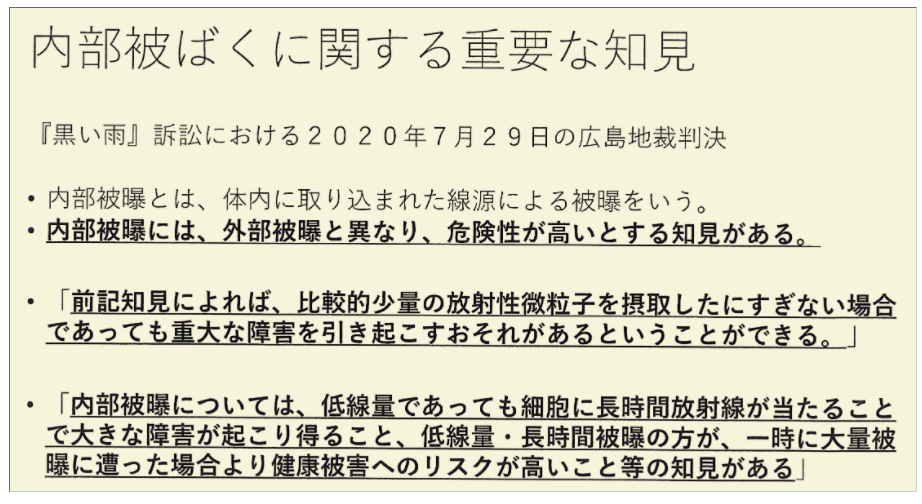
福島県双葉郡富岡町から神奈川県内に一家で避難した男性が意見陳述。一審原告の代理人弁護士は、低線量被曝の健康影響について改めて陳述し、避難指示の有無にかかわらず避難の相当性があると主張した。

[…]

葉山町の実家に避難したが、それまで1人暮らしだった母親は突然の6人暮らしに疲弊した。しばらくして5人は転居したが、神奈川では富岡町の自宅のような広い間取りは借りられない。富岡町では健康そのものだった妻は、ストレスが原因で複数の病気を発症。通院と服薬を続ける事になった。「医師によると、この薬は一生、飲み続けなければいけないそうです」。
 住み慣れた富岡町を追われて9年超。移住した翌年に新築したわが家は、やむなく解体した。「戻りたいけど戻れる状況に無い」。まさに苦渋の決断だった。早く神奈川で落ち着きたいと考えているが、そこには大きな壁が立ちはだかっているのだった。

【自宅解体も売れぬ土地】
 「私たちは今後も神奈川県に住み続けるつもりですが、住民票はまだ富岡町にあります。自宅を解体した後の土地が処分出来ないからです」
 建物は壊す事が出来るが、土地は解体出来ない。売るしか無い。しかし「線量が高いため一戸建ての住宅を建てるには敬遠され、かといってアパートを新築するほど広い土地では無いので買ってもらえない状況です」。土地が売れないまま住民票を移してしまえば、今度は固定資産税の減免措置が受けられなくなってしまう。

[…]

【「避難、人として当たり前」】
 法廷では、一審原告ら代理人の小賀坂徹弁護士が「低線量被曝の健康影響」について、パワーポイントの資料を使って改めて意見陳述した。主張の柱は2つ。①避難指示が出されていない区域からの避難の相当性②避難指示の有無に関わらず避難継続の相当性。

[…]

全文

Posted in *日本語 | Tagged , , , | Comments Off on 【福島原発かながわ訴訟】富岡町から避難した男性が9年半の苦しみを陳述「国や東電は責任認めろ」 弁護士は被曝リスクや「避難の相当性」を主張~控訴審第3回口頭弁論via民の声新聞

Japan PM says plan to release Fukushima water coming soon via ABC News

By MARI YAMAGUCHI Associated Press

[…]

“We cannot put off our decision forever without making a plan,” Suga told a parliamentary session Wednesday, saying the plant is running out of storage space. “Based on discussions and expertise we’ve had, we will further deepen our discussion and responsibly make a decision at an appropriate time.”

A government panel in February issued a report recommending releasing the water into the ocean as the most realistic plan. The government and the plant operator, Tokyo Electric Power Co., or TEPCO, say all radioactive materials but tritium can be safely removed, and that tritium is largely harmless.

The plant now has more than 1.2 million tons of the water stored in 1,000 huge tanks that occupy a large amount of space at the plant. TEPCO says that it will run out of space in the summer of 2022 and that the tanks hamper the decommissioning process.

Suga did not give a timeline, though a decision is expected in weeks, if not months. An actual release would be about two years away because TEPCO still has to set up a facility for a release and have it authorized by the Nuclear Regulation Authority, officials said. A controlled release of the water will take decades.

[…]

Nuclear Regulation Authority chairman Toyoshi Fuketa recently said that tritium below allowable limits is routinely released from nuclear plants around the world. He said he is not concerned about safety, but understands psychological and reputational concerns about the water associated with the Fukushima disaster. He said careful monitoring of the water samples is crucial to gain public understanding.

But some scientists say the long-term environmental impact from radioactive water is unknown and could pose higher risks than explained. Ken Buesseler, a marine biologist at the Woods Hole Oceanographic Institution, said in a recent article that not only tritium but how other isotopes affect marine life should be carefully examined.

Read more.

Posted in *English | Tagged , | 16 Comments

2020.10.22 海洋放出決めるな!緊急行動 via これ以上海を汚すな!市民会議

主催: これ以上海を汚すな!市民会議 13:00 福島県知事への要請書の提出 13:45 記者会見:県庁記者クラブ 14:30 県庁前スタンディングSHOW LESS

Posted in *日本語 | Tagged , | 8 Comments




