動画:海南省に小型モジュール原発 世界初の着工 via APF BB News

中国の原子力開発大手の中国核工業集団(CNNC)は13日、中国最南端の省・海南省(Hainan)で小型モジュール原子力発電所の建設を始めました。陸地で建設される商用の小型モジュール原発としては、世界で初めて着工したプロジェクトとなります。

 この小型モジュール原発は、CNNCが自主開発した技術「玲龍1号」(ACP100)を利用しています。この技術は2016年に世界で初めて国際原子力機関(IAEA)の認可を受けた小型モジュール原発技術です。従来の原発技術に比べ、安全性が高いほか、工期が短く、設置しやすく、電力供給とともに海水の淡水化、冷暖房の供給、工業用の熱供給など多目的に利用できます。

発電能力は125メガワットで、2026年に竣工する予定です。

続きは動画:海南省に小型モジュール原発 世界初の着工

Posted in *日本語 | Tagged , , | 11 Comments

High court rules 84 A-bomb ‘black rain’ victims eligible for aid via The Mainichi

HIROSHIMA (Kyodo) — A Japanese high court ruled Wednesday that 84 people in Hiroshima Prefecture are eligible to receive state health care benefits even though they were exposed to radioactive “black rain” following the 1945 U.S. atomic bombing outside an area currently recognized by the government.

Upholding a lower court decision last year, the Hiroshima High Court ruled in favor of the plaintiffs, saying they should receive the same benefits as those provided for atomic bomb survivors who were in the zone where the state has recognized black rain fell.

[…]

For the recognition of the plaintiffs as atomic bomb victims, “it is sufficient to prove that the possibility of damage to their health due to atomic bomb radiation cannot be ruled out,” said Presiding Judge Kazuto Nishii.

The high court said radioactive rain fell in a wider area beyond the designated zone and the plaintiffs are hibakusha because they are likely to have suffered health damage caused by their exposure to radiation.

The ruling accepted the plaintiffs’ claim that there was also a possibility of internal radiation exposure due to the ingestion of contaminated food and well water.

The defendants had argued there was no scientific proof for nuclear fallout in the area where the plaintiffs resided. Even if they were exposed to radiation, its influence on their health would be insignificant, the defendants said.

When a lawyer raised a banner in front of the courthouse declaring “complete victory” in the suit, supporters of the plaintiffs who had been waiting for the ruling exploded with joy.

“I express my sincere gratitude,” said Masaaki Takano, the 83-year-old head of the plaintiffs. He added the plaintiffs will request that the state, and the Hiroshima prefectural and city governments not appeal the ruling.

Chief Cabinet Secretary Katsunobu Kato told a press conference that the central government will decide on what to do after discussing its response with the Hiroshima governments, as well as ministries and agencies concerned.

Hiroshima Mayor Kazumi Matsui said, “We would like to discuss the matter with the prefecture and health ministry, with the city’s desire to expand the black rain zone in mind.”

Residents of the state-designated black rain zone are eligible to receive free health checkups and atomic bomb survivors’ certificates entitling them to medical benefits in the event that they develop 11 specific illnesses caused by radiation.

But the plaintiffs’ applications for health care benefits for atomic bomb survivors filed with the Hiroshima prefectural and city governments between 2015 and 2018 were rejected as they resided outside the zone, prompting them to sue the governments to seek the nullification of the decisions.

Based on previous research, the central government designated an oval-shaped area measuring 19 kilometers in length and 11 km in width stretching northwest of the hypocenter of the atomic bombing on Aug. 6, 1945, as the zone where black rain fell for an hour or longer.

The local governments, as well as the health ministry had appealed the district court ruling last August, insisting “highly scientific proof” was necessary to determine whether the plaintiffs were in an environment affected by radiation, which is one of the conditions for their recognition as atomic bomb survivors.

Last November, the health ministry launched a review panel of experts to study areas where black rain fell after the local governments asked for the recognized black rain zone to be expanded based on the district court’s ruling.

The panel, which has met five times so far, decided to conduct climate simulations and a soil investigation in addition to analyzing the journals of atomic bomb survivors, but it has not reached a conclusion yet.

The top government spokesman said he expects the health ministry to speedily work on the review as those concerned are aging and their memories are fading, making scientific study of the black rain area even more difficult.

Read more.

Posted in *English | Tagged , , , | 15 Comments

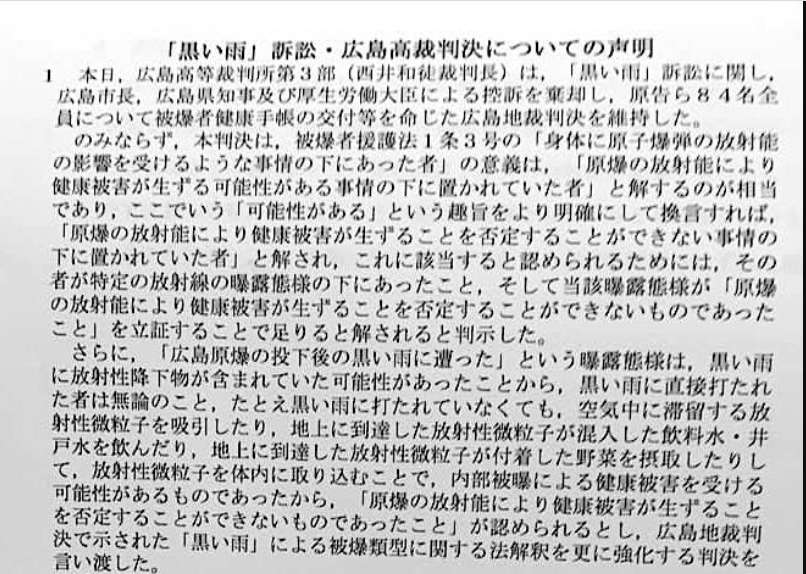
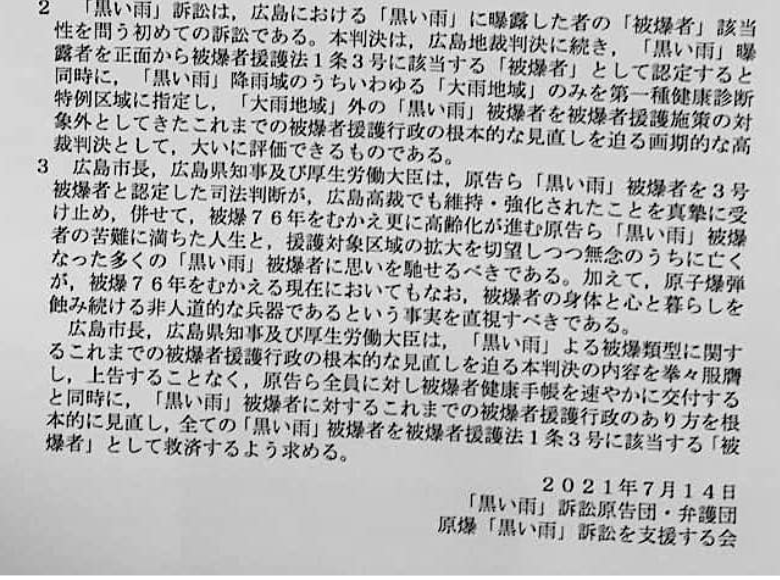
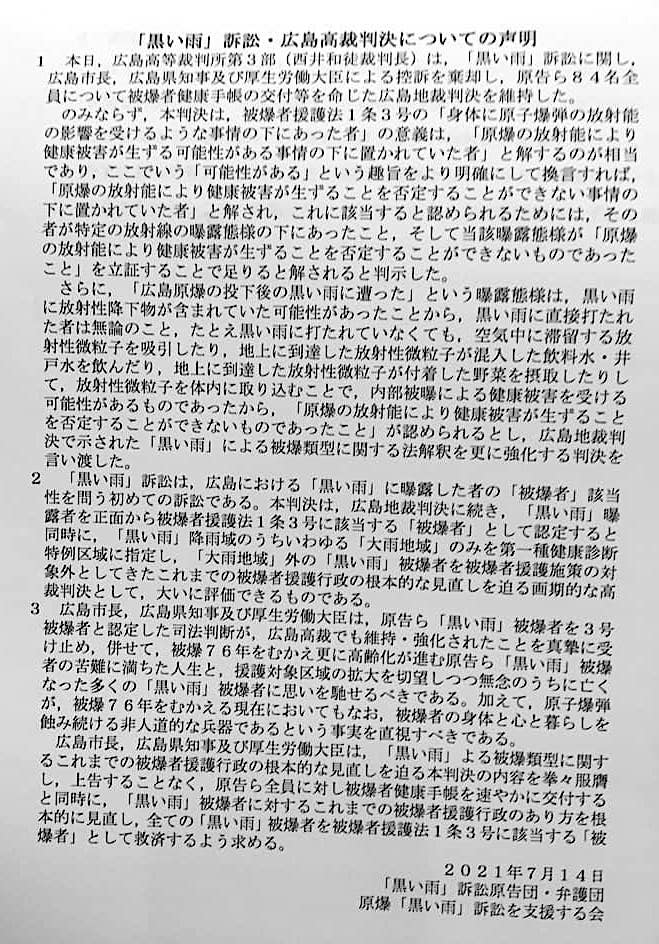
「黒い雨」二審も原告全面勝訴〜広島高裁が対象を広げる判断via OurPlanet-TV

広島への原爆投下後に降った「黒い雨」を浴び、放射性物質による内部被曝をしたとして、住民84人が「被爆者健康手帳」の交付を求めていわゆる「黒い雨訴訟」の控訴審で、広島高裁は一審を支持し、国側の控訴を棄却した。

高裁は、被曝した線量にかかわらず、雨に降った地域のいずれかにいたことが証明できれば、病気の発症前でも被爆者認定すべきだと指摘。1審判決よりも救済対象を広げる判断基準を示した。広島の黒い雨をめぐる高裁判決は初めて。

判決骨子はこちら

弁護団の声明はこちら 

報告集会と記者会見の動画

Posted in *日本語 | Tagged , , | 10 Comments

黒い雨二審も原告全面勝訴 広島高裁、国の検証に影響も via Kyodo News

広島への原爆投下直後に降った「黒い雨」を浴びたのに国の援護を受けられないのは違法として、住民84人(死亡者含む)が広島県と広島市に被爆者健康手帳の交付を求めた訴訟の判決で、広島高裁(西井和徒裁判長)は14日、全員を被爆者と認定した一審判決を支持、県や市、国側の控訴を棄却した。 記事詳細 https://www.47news.jp/news/6521163.html

Posted in *日本語 | Tagged , , | 11 Comments

Exclusive | Hanford workers hospitalized after feeling sick digging at nuclear waste-tainted site via Tri-City Herald

BY ANNETTE CARY

Three Hanford workers spent 24 hours at the Richland hospital last month after reporting headaches, nausea and rapid heart rates at one of the nuclear reservation’s tank farms.

The symptoms were consistent with those linked to inhalation of vapors from the toxic waste held in underground tanks.

Some Hanford tank farm workers have reported serious respiratory and neurological illnesses they suspect are linked to exposure to chemical vapors.

[…]

In this case workers were digging by hand about a foot of soil on June 18 in an area where tank waste had previously leaked or spilled, rather than doing work directly involving the storage tanks.

They were preparing the ground to install a high-density asphalt barrier over the surface at Hanford’s largest single-shell tank farm. The TX-Tank Farm has 12 single-shell waste tanks.

[…]

In this case workers were digging by hand about a foot of soil on June 18 in an area where tank waste had previously leaked or spilled, rather than doing work directly involving the storage tanks.

They were preparing the ground to install a high-density asphalt barrier over the surface at Hanford’s largest single-shell tank farm. The TX-Tank Farm has 12 single-shell waste tanks.

Since the underground tanks were put into service to hold radioactive and hazardous chemical waste in the late 1940s, waste has spilled and leaked into the ground there.

[…]

Three with symptoms were referred from the on-site clinic to Kadlec Regional Medical Center in Richland, where they were held for 24 hours for observation.

Since then, four more workers, at least three of them working on the ground barrier project, have asked for medical evaluations.

[…]

When workers were in the TX Tank Farm they were wearing full-face air-purifying respirators equipped with chemical cartridges, according to the tank farm contractor.

The respirators are less protective than supplied air respirators, which were required for a time for single-shell tank farm work, before an independent review of chemical cartridges was completed.

[…]

However, the cartridges are not rated as protective against all chemicals of concern for human health in tank waste and vapors, said Tom Carpenter, executive director of Hanford Challenge, a worker advocacy group.

[…]

In addition, while disturbing waste in tanks can lead to the release of tank vapors, atmospheric changes also can lead to releases, he said.

The tank farm contractor investigation of the incident is continuing.

[…]

The incident in the TX Tank Farm occurred just before a report was released by the Washington state Hanford Healthy Energy Workers Board that called for the creation of a Hanford Healthy Energy Workers Center to promote better health care for Hanford workers exposed to radioactive and hazardous chemicals.

Read more at Exclusive | Hanford workers hospitalized after feeling sick digging at nuclear waste-tainted site


Posted in *English | Tagged , , | 30 Comments

Nuclear Stockholm Syndrome via Counterpunch

By Robert Jacobs

Bhaskar Sunkara’s recent opinion piece extoling the virtues of nuclear power and castigating its opponents as paranoid and ill-informed, is clearly motivated by his deep concerns over the dire impacts of global warming, which loom closer by the hour. Unfortunately, his arguments amount to little more than regurgitated industry talking points, in their traditional form of a Jeremiad.

First, Sunkara poses the decline of the nuclear industry in the West as an achievement of progressive political movements. Specifically, he cites the decline of nuclear power in Germany as attributable to a “Green party-spearheaded campaign.” This decline has been more reasonably ascribed to both market conditions and missteps by nuclear industry giants such as Westinghouse and AREVA. From its inception, nuclear power has been heavily dependent on government subsidies to appear economically viable (subsidies such as insurance and the disposal of waste largely configured as taxpayer burdens).

Rather than succumbing to its political opponents on the left, the industry has been sunk by its structural economic dysfunctions. In the US, this has sparked schemes to secure additional taxpayer subsidies in legislative fixes such as guaranteed returns for nuclear utilities, and outright bribery of legislators for taxpayer bailouts of failing companies.

The most simplistic recitation of nuclear industry talking points is when Sunkara dismisses concerns about nuclear waste, and extolls the mythic separation between “civilian” and “military” nuclear technologies. He asserts that most nuclear waste “can be recycled to generate more electricity,” an assertion that goes back more than half a century and has been ritualistically recited by an army of nuclear industry PR professionals before him…yet here we are 50 years later and very little spent nuclear fuel has actually been recycled. The most successful nuclear recycling nation is France which, nevertheless, is experiencing a “nuclear exit” and is unlikely to ever use this recycled fuel. AREVA, the French nuclear giant, has gone bankrupt. Reprocessing facilities like the Rokkasho plant here in Japan have never functioned properly, unless you consider their role enabling the stockpiling of plutonium by Japan to hedge against future weapon needs to be an elemental goal.

There is a difference between what can be done, and what actually happens. Rather than being recycled, hundreds of thousands of metric tons of spent nuclear fuel await “final disposal” in deep geological repositories. Some have been waiting for over 70 years. Just last week, a panel advising the EU on categorizing nuclear plant as “green” energy, and thus eligible to receive EU funding as a “sustainable investment,” concluded that the problems of nuclear waste preclude that designation.

[…]

Read more.

Posted in *English | Tagged , , | 19 Comments

【報告集会】南相馬20ミリ基準撤回訴訟 判決の内容は? via FoE Japan

満田夏花

南相馬避難20ミリシーベルト撤回訴訟支援の会の事務局/FoE Japanの満田です。
この国の司法のあり方に打ちのめされる判決となりました。憤りを禁じえません。
わずか12秒。主文を読み上げるだけで逃げるように退室した鎌野真敬裁判長は、
6年間も闘い続け、5時間もの道のりを18回も通った原告の顔を直視した上で、
判決理由を述べることができなかったのでしょう。

司法は、20ミリシーベルトの不当性についても、解除の違法性についても判断を
逃げたといえるでしょう。腐りきっています。

東京地裁の鎌野真敬裁判長は、特定避難勧奨地点の指定解除について「年間の被
ばく線量が20ミリシーベルトの基準を下回ることが確実だという情報を提供する
もので、帰還を強制したとはいえない」として、取り消す対象にはならないと判
断し、住民側の訴えを退けました。

特定避難勧奨地点の指定にも解除にも処分性(行政庁の処分その他公権力の行使
に当たる行為)はないとし、「単なる情報提供」としたのです。また、解除にあ
たって、原告たちが被った不利益もないとしました。許しがたい判決です。

被告である国がこの主張をしたときも驚きましたが、まさかそんなわけのわから
ない主張は通らないと思っていました。司法はそれをそのままなぞった判決を出
したました。以下のような主要論点はすべてスルーしたといえます。

・解除に伴い、一定期間後ではあったが、避難勧奨に伴う公的な支援がすべて打
ち切られたこと。とりわけ、住宅提供が打ち切られ、住民は帰還を余儀なくされ
たこと。
・ICRPが勧告している公衆の被ばく限度としての年1ミリシーベルトを反映して
現在の国の被ばく防護の規制は構築されていること(例:原発の敷地境界線上の
ti年1ミリシーベルトを守る義務を事業者にかしていることなど)
・ICRP勧告では、事故後の現存時被ばく状況を1~20ミリシーベルトとして、そ
の下方から参考レベルを選び、それを1ミリシーベルトに向けて下げるべきとし
ている。実際は、避難指示の指定も解除も20ミリシーベルトであり、ICRP勧告で
すら守られなかったこと
・ICRP勧告や原子力安全委員会の文書、原子力災害対策本部の避難指示解除の用
件で求められていた「住民との協議」がまったく行われず、住民の反対を無視し
て解除されたこと
・解除の空間線量率(3.8マイクロシーベルト/時)の計算式は、屋内を屋外の
0.4であるとして計算されているが、実際には屋内屋外の差は平均0.7くらいで、
実際は屋内の方が屋外よりも高い例もあったこと

こちら判決および判決要旨です。
http://minamisouma.blogspot.com/p/blog-page_89.html

本当に何のために司法が存在するのか絶望的な気持になります。
しかし、国のあまりといえばあまりな20ミリシーベルト基準に、真っ向から立ち
向かった原告のみなさんの勇気は決して無駄になったわけではありません。
この裁判で多くのことが明らかになりました。心から感謝したいと思います。

※南相馬避難20ミリシーベルト基準撤回訴訟とは
2014年12月、政府は、南相馬市の特定避難勧奨地点について、年間積算被ばく線
量が20ミリシーベルトを下回ることが確実になったとしてすべて解除し、その後
順次支援策や賠償を打ち切りました。

これに対して、地点に指定されていた世帯や近隣の世帯合計808名が、解除の取
消しなどを求めて、2015年4月および6月に、国(原子力災害対策現地本部長)を
相手取って提訴しました。
裁判では、年間20ミリシーベルトという基準による特定避難勧奨地点の解除の是
非が争われました。
原告は、年間20ミリシーベルト基準での特定避難勧奨地点の解除は、次の3点か
ら違法であると主張し、その取消し等を求めています。

1)公衆の被ばく限度が年間1ミリシーベルトを超えないことを確保するべき国
の義務に反する。

2)政府が放射線防護の基準として採用している国際放射線防護委員会(ICRP)
の勧告に反する。

3)政府が事前に定めた解除の手続(新たな防護措置の実施計画の策定、住民等
の意思決定への関与体制の確保)を経ることがないまま解除を強行した。

Posted in *日本語 | Tagged , | 12 Comments

また一つ崩れた原発神話 コスト上昇、エネルギー政策への影響は via 毎日新聞

政府が12日に示した2030年時点の各電源の発電コストの新たな試算で、政府や電力業界が原発推進のよりどころにしてきた「安さ」の根拠が揺らいでいる。安全性に続き、また一つ「原発神話」が崩れたことで、原発を重要な電源と位置付けてきた政府の方針や今後のエネルギー政策はどうなるのか。

コストの上限は試算できず

 原発の1キロワット時あたりの発電コストが、前回15年試算時の「10・3円以上」から「11円台後半以上」に1割程度上昇したのは、敷地外への放射性物質の拡散防止といった安全対策費が、1基当たり約1369億円と15年試算時(約601億円)から倍増したためだ。11年に起きた東京電力福島第1原発事故の処理費用の見積もりが15年の「12・2兆円以上」から「23・8兆円以上」に膨らんだことも響いた。他の電源はコストの上限も算出されているが、原発だけ上限がないのは「事故処理費用がどれだけ増えるか見込みづらい」(経済産業省幹部)ためだ。

[…]

もっと読む。

Posted in *日本語 | Tagged , , | Comments Off on また一つ崩れた原発神話 コスト上昇、エネルギー政策への影響は via 毎日新聞

Japan’s plutonium stockpile climbs to 46.1 tons in 2020, first rise in 3 years via The Mainichi

[…]

Plutonium is extracted from spent nuclear fuel generated at nuclear plants, for the purpose of recycling. However, the international community has expressed concerns over Japan’s large plutonium stockpile, saying it could be converted into nuclear weapons.

According to the Cabinet Office report, the latest increase in the nation’s plutonium stockpile was due to the addition of roughly 0.6 tons that had been stored in Britain after being extracted from nuclear fuel but which had not been included in the stockpile due to delayed procedures. As the extraction of plutonium in Britain and France has been completed, Japan has no more unrecorded stockpiles, according to the report.

Plutonium is mixed with uranium to produce mixed oxide (MOX) fuel for use at nuclear power plants. However, none of the nuclear plants in Japan used MOX fuel in 2020. As a result, the domestic stockpile remained at the same level as the previous year, at roughly 8.9 tons.

If the nuclear fuel reprocessing plant operated by Japan Nuclear Fuel Ltd. in the village of Rokkasho, Aomori Prefecture, goes into full operation in fiscal 2023, Japan’s plutonium stockpile will increase. However, only 0.6 tons of plutonium is expected to be extracted from spent fuel at the plant in fiscal 2023.

Meanwhile, the Federation of Electric Power Companies of Japan (FEPC), comprising major domestic power utilities, plans to consume 0.2 to 1.4 tons of plutonium per year between fiscal 2021 and 2023.

JAEC Chairman Mitsuru Uesaka commented, “The stockpile will be on a downward trend from here on.”

In the wake of the nuclear meltdowns at the Fukushima Daiichi Nuclear Power Station, only four reactors capable of using MOX fuel have been restarted, including the No. 3 and No. 4 reactors at Kansai Electric Power Co.’s Takahama Nuclear Power Plant in Fukui Prefecture. While the FEPC aims to increase the number of such reactors to at least 12 by fiscal 2030, thereby consuming 6.6 tons of plutonium per year, there are no prospects of being able to activate other reactors or of local bodies and residents giving the green light for such a move.

(Japanese original by Ei Okada, Science & Environment News Department)

Read more.

Posted in *English | Tagged , , | Comments Off on Japan’s plutonium stockpile climbs to 46.1 tons in 2020, first rise in 3 years via The Mainichi

シンポジウム 原発事故 避難の現実via 東海第二原発 避難問題を考える

Posted in *日本語 | Tagged , , , | 11 Comments