東京電力福島第1原発事故で避難し、平成23年7月に自殺した福島県川俣町、渡辺はま子さん=当時(58)=の遺族に対する賠償を東電に命じた8月26日の福島地裁判決について、東電は5日、控訴を見送る方針を固めた。
遺族4人が「自殺は避難生活で精神的に追い詰められ、うつ状態になったため」として東電に計約9100万円の損害賠償を求め、福島地裁判決は約4900万円の支払いを命じた。
当サイト既出関連記事:
関連記事:
東京電力福島第1原発事故で避難し、平成23年7月に自殺した福島県川俣町、渡辺はま子さん=当時(58)=の遺族に対する賠償を東電に命じた8月26日の福島地裁判決について、東電は5日、控訴を見送る方針を固めた。
遺族4人が「自殺は避難生活で精神的に追い詰められ、うつ状態になったため」として東電に計約9100万円の損害賠償を求め、福島地裁判決は約4900万円の支払いを命じた。
当サイト既出関連記事:
関連記事:
(抜粋)
放射性雲の拡散はこれまで、「緊急時迅速放射能影響予測システム」(SPEEDI)を使ったコンピューター計算に各地の空間線量や航空機による観測データを突き合わせて推定してきた。
今回、環境省が各都道府県に設置している自動車の排ガスなどを常時監視する装置に着目。東京大大気海洋研究所や首都大学東京などに依頼し、大気中 に浮遊するちりを1時間ごとに捕まえたろ紙を9都県約90カ所の測定局から回収して、3月12〜23日分の放射性物質濃度を調べた。
その結果、福島市の一つの測定局では15日夜、放射性セシウム137と134の濃度が1立方メートルあたり最大計45・5ベクレルを計測した。 16〜19日も、原発から放射性雲が出続けていたと考えられるが、西風で太平洋側に運ばれたため、大気中濃度は上がらなかったらしい。その後、風向きが変 わり、20日午後3時に同計104・1ベクレルに高まり、その状況は21日朝まで続いた。
雨が降った15日は放射性物質が地表や家屋に沈着し、空間線量が1時間あたり20マイクロシーベルト程度まで急上昇したため、放射性雲が飛来した ことが広く知られているが、雨が降らなかった20〜21日は、既に高くなっていた空間線量計の値が目立って上昇しなかったため、放射性雲が見過ごされてき たと考えられる。
関東地方では、15日と21日の2回、帯状に高濃度の放射性雲の拡散が確かめられた。特に21日朝は茨城県南部や千葉県北東部で放射性セシウム濃 度が急上昇。その後、東京湾北東沿岸部へと南西に移動した。その間、雨で沈着し、各地で「ホットスポット」と呼ばれる局地的に線量の高い場所を作ったとみ られる。
原子力規制庁は4日、日本原子力発電敦賀原発2号機(福井県)の断層を検討する原子力規制委員会の会合で、原電側の説明者が規制委側の有識者を脅すような不適切発言があったとして、原電に厳重抗議することを明らかにした。敦賀原発の敷地周辺の地層や断層について議論していた際、規制委側と原電側の主張がかみ合わず、会合は予定時間を大幅に超えた。4時間近くたったころ、有識者の堤浩之・京都大准教授が地層構造について質問したところ、奥村教授はいらついた様子で「議論を聞いていないのか」などと発言し、声を荒らげる場面もあったという。
奥村教授の発言に対し、堤准教授は「ムッとした。あんな言い方では冷静な判断ができない」と述べ、規制庁は「明らかに脅しで審議の妨げになる」として厳重抗議することにした。【鳥井真平】
全文を読む。
FUKUSHIMA – Newly appointed reconstruction minister Wataru Takeshita visited Fukushima Prefecture on Thursday, as evacuees from the triple core meltdown in 2011 raised concerns about his selection for the post.
[…]Residents in areas hit hard by the Great East Japan Earthquake in 2011, however, have raised concerns about the prime minister’s new Cabinet members, including the reconstruction minister and the central government’s stance toward local recovery efforts.“A lawmaker from one of the Tohoku prefectures of Fukushima, Iwate or Miyagi was not appointed, and it strikes me that we are not being taken seriously,” said Masaatsu Amano, a 76-year-old resident living in temporary housing in the city of Koriyama.
Amano, who is originally from Futaba, one of the towns co-hosting the heavily damaged Fukushima No. 1 power plant, evacuated with the other residents to escape the radiation ejected by the crippled plant.
“I wonder if the government’s attention is too focused on national security issues and the (2020) Tokyo Olympics, and if the disaster-hit areas will be left behind,” he said.
[…]
“Nothing has been reconstructed. Whoever takes the post, it won’t make any difference,” said a 62-year-old female evacuee.
Read more.
This is a translation of an interview article posted online on August 30, 2014, by a Japanese freelance journalist, Hiroki Suzuki. Suzuki runs a site called, “Tami no Koe Shimbun,” or “People’s Voice Newspaper,” where he posts interviews of various people in Fukushima. The article was translated with permissions from Suzuki and the interviewee.
[…]
【Doubts About “Safety Promotion” at an Early Age】She has been interested in nuclear power plants since in grade school. School textbooks only showed merits of nuclear power plants, but she says, “I was lucky to have a teacher who also taught us risks of nuclear power plants.” At the time, there were always events held in Fukushima City during summer breaks for “safety promotion.” She went to them every summer, but she never totally believed them. In the ninth grade, one of the summer homework assignments was to collect and summarize newspaper articles. You choose a theme, collect related articles, and summarize them. She chose “pluthermal, or plutonium-thermal use” as her theme. Recycling of uranium and plutonium collected during the reprocessing of spent nuclear fuel. She even read a book about it, and the more she dug into it, the more doubtful she became. She said “Only safety was emphasized. Why are they doing ‘safety promotion’?”
Therefore, it was natural that she began to seal all windows when returning home, in an attempt to protect her family from radiation, to the point where her father said, “Is all that really necessary?” She was pre admitted to high school during the first semester, so she didn’t have to go to the prefectural high school entrance examination result announcement which was held despite high radiation levels. However, she had to go and register for high school entrance, which meant she had to physically go to the prefectural high school she was admitted into. She covered herself with a mask and a muffler, minimizing skin exposure, and she washed her face carefully upon returning home. Even with all the precaution taken, the result of her thyroid ultrasound examination, done in January 2012, nine months after the high school began, was “A2” (nodules equal to or smaller than 5 mm or cysts equal to or smaller than 20 mm).
“I am worried if my future children will be affected when I get married and have babies.”
[…]
In the last 3 years, her parents tried various means of avoiding radiation exposure to protect her. She knows it will be difficult to evacuate out of Fukushima Prefecture for a financial reason and also because of caring for her ill grandparent. As her parents have tried hard, she thinks her family might be more protected than the others. She also feels anxious and lonely about living alone.She thought about it for a bit, and announced, “I was accepted into a particular high school I wanted to get into, in order to be closer to what I want to do in the future. I am afraid of destroying what I have by evacuating. Also, it’s my own life. I should be the one to decide.”
Her dream is to become a space engineer. She says with a smile, “I want to develop an engine for a space probe.” Two years ago she participated in a overnight learning camp at the Japan Aerospace Exploration Agency. She heard stories from an astronaut, Naoko Yamazaki. In order to fulfill her dream, she is studying to get into Tohoku University School of Engineering. “But I haven’t given up my other dream of becoming a dancer. I want to do both.” This year, she didn’t do well on the college entrance examination due to an illness. She commutes to a college preparatory school in Sendai, aiming to gain acceptance into Tohoku University next spring.
“What people think about radiation exposure and evacuation isn’t black and white. It might be gray close to being white, or gray close to being black. Perhaps another color would blend in. Many people think of radiation the same as air, but some people are working very hard to reduce the risk. I would like people outside Fukushima Prefecture to understand that.”
Two and a half year since the last examination, she had a repeat thyroid ultrasound examination at Fukushima Medical University. After the ultrasound examination, she said, “I saw cysts on the monitor.”
Read more.
BRITISH scientists secretly used the Australian population to test for radiation contamination after the nuclear tests at Maralinga in the 1950s, a new book confirms.
Its author, Frank Walker, has obtained the minutes of a top secret meeting in England where the UK Atomic Energy Research Establishment approved a program to determine the long-term effects of the tests on Australia and its citizens.
In his book, Maralinga, Walker details how the meeting at Harwell on May 24, 1957, decided to first obtain soil samples from pasture regions near Adelaide, Sydney, Melbourne, Brisbane and Perth to check for fallout from the nine nuclear bombs detonated at Maralinga and the Monte Bello Islands, off WA.
The second phase was to test vegetation, particularly grass and cabbage, and milk for the presence of the radioactive isotope, Strontium-90, a fission by-product of nuclear explosions.
[…]
According to the document obtained by Walker, Professor Titterton told the meeting he wanted to collect animal bones “to see if Strontium-90 is getting into domestic animals”.
The meeting decided to take bone samples from 12 sheep stations along a 800km path of fallout tracked by Royal Australian Air Force planes which flew into the mushroom clouds following each nuclear explosion at Maralinga.
[…]
Professor Titterton told the meeting that the final phase of the testing would be to determine if Strontium-90 was being absorbed by the Australian population.
“We have to find out if Strontium-90 is entering the food chain and getting into humans,” says the document, which has the file number DEFE 16/608.
The scientists then agreed to start testing the bones of dead Australian infants and children for radiation contamination.
[…]
As The Advertiser has previously reported, hundreds of bones were subsequently collected from the bodies of 21,830 dead babies, infants, children, teenagers and young adults across Australia without the knowledge of their parents.
The Strontium-90 testing program in Australia was the longest of its kind in the world, finally ending in 1978.
Related articles:
Heysham 1 and Hartlepool reactors are offline as Britain’s electricity system struggles with retirement of old plants
Two nuclear stations that play a vital role helping to keep Britain’s already fragile electricity system intact could be out of action till the end of the year, EDF Energy said on Thursday.
The ongoing problems at Heysham 1 and Hartlepool reactors, taken offline last month, forced Centrica, a 20% owner of the atomic fleet with EDF, to issue a profit warning.
[…]
The power outages following the discovery of a fault on a boiler “spine” at Heysham 1 have already led the National Grid to fast-forward an emergency plan to obtain more electricity from other providers to meet a possible shortfall.
The Heysham 1 and Hartlepool nuclear plants have a combined capacity of about 2.4 gigawatts (GW) and are out of action at a time when part of the 2GW Ferrybridge coal-fired station is also temporarily closed down due to a fire. The margin between supply and demand inside UK’s electricity system is already very low due to the retirement of old nuclear and coal plants.
EDF Energy operates 15 nuclear reactors in Britain but its other reactors have a different boiler design and the company said it did not see a risk of them suffering from the same fault.
Read more at Two nuclear power stations could be out of action until December, says EDF
Peace camp outside base since 1982 sees yes vote as ending UK’s entire nuclear deterrent but electorate is more ambivalent
One of the biggest targets for Scotland‘s independence campaign sits behind a high, intimidating wall of reinforced security fencing and curling banks of razorwire in the southern Highlands: Faslane naval base, home to Britain’s nuclear missile fleet.
Stretched along the shoreline of a secluded sea loch underneath the gnarled mountains of Argyll, Faslane has been a focus for often large protests for decades. Tens of thousands of peace campaigners have laid siege to its gates, hacked at its fence and blocked nearby roads in protest; some have sneaked in by sea, once clambering inside a Trident submarine.
And in two weeks time, Scotland’s voters may just decide to get rid of it.
Opinion polls suggest the independence movement may be on the brink of an extraordinary victory in the referendum on 18 September: after months of trailing the pro-UK campaign by at least 14 percentage points, two polls, by YouGov and Survation, suggest the yes campaign needs just a 3% swing to win.
[…]
“The position of the Scottish government is absolutely clear: following a yes vote, Trident will leave the Clyde as speedily as possible,” he said.
“There is no room for any ambiguity. This is not just because it will be the settled will of the Scottish people in the referendum but also because Whitehall will wish to have 100% control of its nuclear deterrent.”
For Jamie Watson, 32, a former trainee nurse, it would be a remarkable moment. One of a small group of people living at Faslane peace camp, which has continuously occupied a roadside verge near the base since 1982, Watson believes a yes vote could force the UK to abandon nuclear weapons entirely.
“This would be a challenge to the plans to replace Trident and another 50 years of nuclear weapons,” he said. “It’s very high stakes because we’ve now got to the prospect of real pressure being put on Westminster, to challenge what they’re planning.”
Read more at Scottish voters contemplate the nuclear option for Faslane’s Trident fleet
東京 4日 ロイター] – 小渕優子経済産業相は4日、ロイターなどのインタビューで、原子力発電への将来の依存度を含むエネルギー・ミックス(電源構成比)に関する政府目標の設定について「できるだけ早く設定したい」と述べた。
政府は、原発事故前に約3割だった依存度を「可能なかぎり下げる」との方針だが、小渕経産相は、具体的な数値や水準のイメージは示さなかった。
4月に閣議決定した政府の「エネルギー基本計画」では、原発について「重要なベースロード電源」と位置づける一方で、「可能な限り依存度を低減させる」としており、矛盾した内容との批判がある。
小渕氏は、将来の原発依存度は3割を下回る水準が基本方針かとの質問に対して、「30%を切るのか切らないのか、いまの段階で何%かを示すことほはできない」と述べた。
(略)
特に、原発から出る放射性廃棄物の最終処分場のめどが立っていない実態は、長年、「トイレなきマンション」と揶揄され、原子力政策の先送り体質の象徴だ。
また、巨大な原発事故に金額面でまったく対応できないことが国民に知れ渡った原子力賠償制度の見直しも大幅に遅れている。
小渕経産相は、最終処分場の確保について、「いまの時代を生きる世代の責任として解決していかなければいけない課題。国が主体的にかかわる」と述べた。
原子力賠償制度の見直しについても、「国の責任のあり方については、関係省庁が参加して原子力賠償制度の見直しに関する副大臣等の会議で検討がされている」と語った。
TOKYO — About 650 workers who fled the stricken Fukushima Daiichi power plant without permission at the darkest moment of the 2011 nuclear accident may have left because they thought they had been ordered to evacuate and were not knowingly violating orders, according to new details of the episode reported in recent days by Japanese news media.
[…]
While the new reports carry much of the same information as the earlier Asahi account, they differ on the key point of whether the plant’s workers who fled on March 15 were consciously violating Mr. Yoshida’s order for them to stay where they were. The Asahi report quoted Mr. Yoshida as saying he had never given the order to withdraw, indicating that the evacuation went against his instructions.However, additional excerpts from Mr. Yoshida’s testimony cited in the new reports suggest a communication failure, not a willful violation of orders by the employees.
“It was like the telephone game,” in which a message gets distorted as it is whispered from person to person, Mr. Yoshida is quoted as saying in the new reports. “I said, ‘If we go, should it be to 2F?’ while the people who heard me gave the instruction to the drivers to go to Fukushima Daini.”
Mr. Yoshida was referring to the drivers of buses that were being brought to the damaged plant for a possible evacuation. Those buses helped carry the fleeing workers to the unharmed Fukushima Daini nuclear plant, also known as 2F, despite the fact that the evacuation order was never given.
The new excerpts also reveal that Mr. Yoshida feared that the accident could grow into a broader disaster that might have threatened all of eastern Japan, a region that is usually taken as including Tokyo, about 150 miles south of the destroyed plant.
“Our image was a catastrophe for eastern Japan,” Mr. Yoshida said in the testimony, according to Kyodo. “I thought we were really dead.”
Read more.



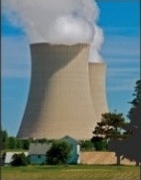
A nuclear power plant in Byron, Illinois. Taken by photographer Joseph Pobereskin (http://pobereskin.com).