“Take Science Seriously and Value Ethics Greatly”: Health Effects of Fukushima Nuclear Disaster via The Asia-Pacific Journal/Japan Focus


Interview with Hisako Sakiyama, M.D. & Ph.D.

By Katsuya Hirano & Hirotaka Kasai

Translated by Akiko Anson

Introduction

Hisako Sakiyama has a PhD in Medicine and is a Member of the Takagi School of Alternative Scientists, a Japanese NGO established in 1998 to study the environment, nuclear issues, human rights, and other issues in modern society from the perspective of citizens. The School seeks to create ways that scientists and prospective scientists can link their specialized expertise and capabilities with citizen movements. She has been a Research Associate at MIT and worked on cancer cell biology as Former Senior Researcher at the National Institute of Radiological Sciences (NIRS) in Japan. Sakiyama served as a member of the Fukushima Nuclear Accident Independent Investigation Commission (NAIIC), a commission established by the Japanese Diet in 2011. She subsequently co-established the 3.11 Fund for Children with Thyroid Cancer with Ruiko Muto in 2016. As a former member of the Fukushima Nuclear Accident Independent Investigative Commission, Dr Sakiyama continues to be active in sharing her findings, which often contradict those of the Japanese government and its associated scientists’ in terms of their evalution of the health effects of the nuclear disaster, with media and citizens around the world (K.H.).

[…]

Cover-up Culture and Social Pressure

Hirano: I see. There are two things to note here; one is the systematic cover-up practices of the government, and the other is the so-called social pressure that makes victims unwilling to talk about radiation concerns in public. When you think of Fukushima’s current situation and the possible health consequences of the incident, which of those do you think poses a more serious problem to society?

In other words, is it more important to build a society where people can say well, I may be seen as strange for this, but I am worried about my child’s health, so they can be open about discussing ways to protect children’s health? Or is it more crucial to try to change the cover-up practices of the government — which, honestly, I don’t really know is possible? Of course, both of these things should change.

Which change should come first in your opinion?

Sakiyama: Well, it is citizens who can change the government. For example, the Education Ministry initially did not even acknowledge the recuperation program for children in Fukushima, but as more private individuals got involved through NGOs and other means, and people in Fukushima petitioned for financial assistance, the government finally had no choice but to agree to fund the program.

There is no way that the Education Ministry would have changed right away without pressure from citizens. And there is no way that the Ministry of the Environment will change without pressure from citizens. We need to make it happen. We are the ones who elect public officials.

So, I think that citizens will have to change and initiate movement in politics and government. I agree with you that change will not start with the government; it will not abandon the cover-up by itself. For example, can you even imagine the possibility of the International Nuclear Power Village ( changing its course? Maybe if they were broken there may be a change, but I don’t think it’s possible considering how powerful the organization is.11 The only possibility left is that we, citizens, change politics through our own actions.

The Japanese public now favors phasing out nuclear power. And Japan’s renewable energy industry has been growing rapidly.

Have you heard about an organization called Genjiren (原自連)? It’s an antinuclear, pro-natural energy confederation. The ‘ji’ 自actually refers to natural energy (自然エネルギー).

Kasai: It must be named to contrast with Denjiren (電事連), the Federation of Electric Power Companies of Japan.

Sakiyama: Exactly. Genjiren is headed by Mr. Kawai Hiroyuki, a lawyer; former Prime Minister Koizumi Junichiro; and Mr. Yoshiwara Tsuyoshi, a former president of Jonan Shinkin Bank. Indeed, the renewable energy market in Japan has been growing very vigorously over the past decade.

There are various sites throughout Japan that generate electricity on a small scale. I heard that altogether there are more than 500 of these nationwide. If we continue to promote and invest in renewable energy, there is a chance to create a largely non-nuclear and fossil fuel-free future.

Running nuclear energy is almost too expensive considering capital costs for building nuclear plants, the challenges of disposal of nuclear waste, and the risk of meltdown. So we have to keep spending money in order to sustain nuclear power, not to mention the cost of decontamination after the accident. It would be a disaster to discontinue the decontamination work due to lack of money. It’s time to just end the whole nuclear business – you know, like they say, “when poverty knocks at the door, love flies out of the window.” (laughs)

Right now the government seems to have money and keeps throwing it at general contractors. The thing is, though, these construction companies have made so much profit building the nuclear power plants, and after the accident they have made huge profit through decontamination work. How terrible is that?

Hirano: I agree. In English, it is called Disaster Capitalism.

Kasai: It is 災害便乗資本主義 (saigai binjō shihonshugi) in Japanese.

Sakiyama: That’s right. Exactly.

Hirano: They can fail and still make a profit.

Sakiyama: Actually, I believe that it is badly poisoning Fukushima. The decontamination work keeps some tiny share of money flowing into the prefecture, and it also provides employment opportunities for those who are over 18 years old. Considering how scarce jobs are in that area, the decontamination work has been giving them plenty of steady job opportunities.

A friend who is a physician told me once that young people, after graduating from high school, come to her clinic seeking health screening. They want documentation to prove they are healthy enough to work at the decontamination sites. My friend tells them that it’s a bad idea, but they say there’s no work, so they end up working there anyway.

Scientists and Civic Engagement

Hirano: I would like to move on to the next question. What kind of role do you think a scientist with specialized knowledge should play in civil society? This has to do with what you have been doing through the Takagi School.12

Mr. Kasai and I were talking about this before this interview – until recently neither of us have read through scientific journals. At first, they seemed to be rather difficult for people like us, with so little science background. But after the nuclear disaster, it seems that some scientists who have strong social and civic consciousness started to publish very accessible papers in science-related journals. As we moved forward with this Fukushima interview project, we came to realize how important the role of these scientists has been in providing their knowledge to the general public in order to build a democratic civil society going forward. What kind of social role do you think those who have expertise in medicine and science should play in the future?

Sakiyama: The most important thing for us, in my opinion, is education. Education is the top priority. However, the Education Ministry is in charge of education, and they promote myths about nuclear power safety right from elementary school. We really need to figure out how to deal with that.

The anti-nuclear movement has simply have not been involved in doing something about education. There are a few teachers who are interested in nuclear energy education, but they are an absolute minority. Still, we decided to team up with some educators and formed an organization called the Committee for Nuclear Power Education 原子力教育を考える会, and in around 2005 we created a website “Understanding Nuclear Power”「よくわかる原子力」.

The Takagi School hosted some public lectures about nuclear energy and environmental education, and teachers from all over the country made presentations. We decided to form a group, the Committee for Nuclear Power Education.

We wanted to counter the Ministry of Education, for example by writing our own textbook, but then we realized that we didn’t have enough financial resources to do so successfully. It can get very expensive when we consider the expenses associated with publishing textbooks, such as printing costs and so on.

Then we agreed that the best way would be to create our own webpage, and, actually, my daughter helped get it started.

We also needed to figure out a way to make our information available for lessons at school, so I gave some suggestions to teachers as to what information we’d like them to introduce in classrooms. But they said that they couldn’t use it, since what they can teach during lessons is pretty restricted due to educational guidelines, and they know those restrictions very well.

They are required to write lesson plans, and they said their principals would not approve the plans if the teachers put it in the plans, so the only way to get our information or messages across for them is to walk that fine line somehow.

Then we decided to produce a set of educational DVDs called “What’s REAL about Radiation” (放射線のホントのこと) for classroom use for junior high and high school students. The first volume, ‘What is Radiation?’ covers the scientific aspects, including what exactly happened in Fukushima, how radioactive materials spread in the air, what kinds of effects radiation can cause to living things, and what we should do to protect ourselves from radiation exposure.

The second volume, ‘What is going on in Fukushima now?’ focuses more on social consequences of the disaster in local communities and social issues faced in Fukushima. In order to introduce ‘real voices’ from Fukushima, we visited various places throughout the prefecture, conducted interviews, and compiled them, along with some photos of the current situation in the evacuation areas, as well as of the millions of bulk bags full of radioactive soil stacked in huge piles.

As you know, even seven years after the Fukushima disaster, people are still being exposed to radiation from radioactive fallout. The victims are still suffering, but these struggles have been largely neglected. We have less and less r media coverage on Fukushima. So, it is our hope that the DVDs will give children a chance to learn about not only what has happened and what is happening in Fukushima, but also what radiation really is and what they should and can do to protect themselves.

Children don’t know about these things. In order for teachers to use these DVDs in the classroom, we managed to make each of them about 20 minutes long. They come with supplemental worksheets that help teachers give more detailed explanations and encourage classroom discussions. But the reality is that very few teachers use them in the classroom.

The video created by the Education Ministry is up online, so anyone can watch it. Have you seen it? It’s awful. I have to question if it is even okay to teach the things it claims.

One member of the Committee for Nuclear Power Education had an opportunity to visit Belarus and learn about how children learn about radiation after Chernobyl. I believe the school he visited was one of the more liberal institutions, but according to him, preschoolers were taught through a kind of a fairy tale.

The story goes like this. There was a castle. One day the fireplace at the castle was broken and a radiation queen popped up and ran outside of the castle. Her henchmen also got out and are hiding inside food. So do not eat such food. Or wash the food before eating it, or cook the food before eating it.

That’s how they teach small children to protect themselves from radiation. They seem to focus on training children from a young age to be able to protect themselves without parental help and give them the knowledge they need to keep healthy.

When I went to Ukraine as a member of the National Diet of Japan Fukushima Nuclear Accident Independent Investigation Commission, I noticed that they don’t really treat radiation as something special. Instead, they talk about radiation along with other dangers in daily life. What do you do if there is a burglar, or what do you do if there is a car accident, and, right along with that, what do you do about radiation. They teach it as a normal part of protecting your body.

From that perspective Japanese children are totally vulnerable when it comes to protecting themselves. All they have heard about radiation is that no one can avoid it since radiation is everywhere, and is useful in various fields including industries and medicine. They are also taught that the risk of radiation less than 100mSv is equivalent to lack of vegetables or exercise — without showing any evidence for such claims. The message is that a low dose is okay and there is no need to worry about radiation anymore.

Have you heard about a new information and learning facility, called “Comyutan Fukushima” コミュタン福島? The Fukushima prefectural government opened it in Miharu town as a part of the Center for Environmental Creation in 2016.

They claim that the facility teaches visitors about radiation and Fukushima’s environmental restoration activities through interactive fun activities, such as games, crafts, and a simple science experimenta.

In my opinion, however, what they are trying to do is to instill inaccurate knowledge about radiation. Their main message is that we are all surrounded by naturally occurring radioactive materials on a daily basis, and we are also exposed to man-made radiation such as X-rays; therefore, there is no need to worry about what happened in Fukushima. This is nothing but brainwashing, which is making people, especially children and young people, defenseless against radiation. It is very dangerous. The young will not know how to protect themselves from radiation, and in the end, they will suffer health effects if something happens.

Hirano: It sounds as if safety is being abandoned to a myth of safety. This has to be the most serious adverse effect of the safety myth on individuals.

Sakiyama: Absolutely.

Hirano: So, contrary to Comyutan Fukushima, Belarus has successfully created an educational program that teaches children the risks of radiation very clearly, so they will learn how to protect their own safety.

Sakiyama: Yes.

Hirano: Where do you think such differences are coming from?

I don’t want to draw a conclusion just on the basis of cultural comparison. But as you mentioned earlier, in Japan, in particular among mothers with young children, it has become almost taboo to talk about concerns about the effect of radiation on their children’s health.13 I have to wonder why this kind of social phenomenon is happening.

Do you think it has something to do with a low level of awareness of rights to wellbeing in Japan? In other words, do you think the problem comes from a lack of public awareness that we have right in order to protect our livelihood or ourselves?

Sakiyama: I think so. In general, Japanese people have a low awareness of human rights.

Kasai: I agree. It’s indicated just in the word itself, Okami お上,14 we are not used to critically examining what the authorities say and then making our own judgments. That is one thing that is lacking in our education system. This has been a problem in Japan even before the nuclear power accident. I feel that more people ought to be angry with the current political situation in Japan. You know, if a burglar broke into your house and stole things, you’d be upset, wouldn’t you? But even though it’s widely discussed that the taxes you paid have been misused, a lot of people are not upset about it. In some sense, I feel that people’s engagement with public affairs is weak. So it seems to me, as you pointed out earlier, that this is the result of something that has been perpetuated in society through our education over the years, rather than coming from some essentialist notion about Japanese culture.

When we asked earlier what kind of role scientists should play in civil society, you answered that it should be in education. As an educator myself, I totally agree. I feel that the problem is serious and there is a need for change.

Sakiyama: By and large the people who have been diagnosed with thyroid cancer do not seem to be angry with the central government or TEPCO, who are responsible for the nuclear disaster. Instead, they have been trying to hide from the public.

The other day some members of FOE (Friends of the Earth International) from Germany came to visit us, so I asked what they thought of this. They said if it were in Germany, the thyroid cancer patients would be very angry for sure, and file a suit to get compensation.

I would really like to tell them that they are the victims, and that they should not feel ashamed at all for having gotten thyroid cancer. It is the central government and TEPCO that should be ashamed and held accountable. Unfortunately, it’s the opposite of that, since most victims are still living in the shadow of the nuclear disaster.

Hirano: That is what I have been very concerned about. Really, society should be supporting these socially vulnerable people, but that is not the society we have in Japan. Instead, they have to face the stigma attached to radiation exposure, and the victims fear becoming the targets of social opprobrium if they speak out. This is causing them to suffer from fear and psychological trauma. All these factors have led to a situation where the victims are pushed into a corner and forced into hiding. That’s what most worries me.

These massive cover-ups from the government are not new or uncommon, especially as relates to nuclear power, even outside Japan. But the fact that citizens are creating social pressure against the victims means that citizens are taking the side of the government without even realizing it, and is building a structure of discrimination and oppression.

Kasai: As you mentioned earlier about Ukraine and Belarus, we should have a more active debate regarding both social issues and scientific subjects such as radiation. We only have one interpretation that is widely circulated and shared. What we need, at a minimum, is to introduce other views on the same footing, and then listen to and discuss them thoroughly before making a judgment.

If we don’t exercise a process like that, we won’t be able to break our patterns of uncritically accepting whatever teachers say, or whatever the government or other authorities say, and we’ll have no other recourse even if we think something is troubling. I think this is a very important issue we Japanese face.

Sakiyama: I agree with you. In that sense, it is imperative that scientists work very hard not to just get on the good side of the government and authorities, but to convey scientific facts and disseminate truth to citizens.

Hirano & Kasai: Thank you very much for speaking with us today.

Read more.
Posted in *English | Tagged , , | Comments Off on “Take Science Seriously and Value Ethics Greatly”: Health Effects of Fukushima Nuclear Disaster via The Asia-Pacific Journal/Japan Focus

「黒い雨」訴訟判決控訴抗議声明via ひだんれん

2020年9月29日

   2020年7月29日広島地方裁判所は、「黒い雨」裁判に関する判決を下し、原告84名全員への被爆者健康手帳交付を広島市・広島県に命じた。これに対し参加行政庁厚生労働省、被告広島市及び広島県は、判決が「科学的知見に基づいていない」として、8月12日広島高等裁判所に対して控訴した。

  この控訴は判決が含む実証性・科学性を否定する反科学的意図を含むものであり、被爆者健康手帳交付を徒に遅らせ、「黒い雨」被爆者救済を先延ばしするものである。よって厳重に抗議し、控訴取り下げを求める。

さらに、広島地裁判決は、内部被曝による健康被害の可能性を認め、地理的線引きによる被害者の特定を否定した点で、福島原発事故による広範な放射線被曝被害を正しい解決に導く一つの指針である。高度約600mで核爆発した原爆であったことと、地上で核事故を起こした原発であったこととの違いがあるだけで、膨大な核分裂物質が環境中にまき散らされ、周辺住民を生涯にわたって不安と健康被害に陥れる事実に変わりはない。

広島地裁、高島義行判決は現時点での英知の結晶であり、決して闇に葬ってはならない。

国・広島市・広島県の控訴は、戦後75年経過してもなおかつ未解決の「黒い雨」被爆者救済を、徒に遅らせるという点で不当である。「黒い雨」被爆者は原告になった84名だけではない。調査によれば数千人規模の被害者が存在すると言われる。

   控訴せずとも、判決を機に今回認定された「黒い雨」被爆を広島原爆被害の「類型」として認め、「黒い雨」降雨域の範囲を新たに認定し、政令を改正すれば済む話である。これで数千人といわれる「黒い雨」被爆者を救済できる。にもかかわらず控訴して、救済に時間をかけようとする国、広島市、広島県の姿勢は到底容認できない。

さらに、広島地裁判決のもつ科学性・実証性が、核産業にとって、そして核産業推進を掲げる現政権にとって都合が悪いからという理由でこれを「非科学的」と論難し、自らの都合だけで広島地裁判決をなかったものとして闇に葬り去ろうとする国の「控訴理由」は極めて不当である。

私たちの国は、福島原発事故という未曾有の「放射能大惨事」のただ中にある。現に「福島第一原発事故による原子力緊急事態宣言」は、2011年3月11日以来継続中である。宣言解消のメドすらたっていない。

   長期低線量被曝、特に内部被曝被害を考えて見たとき、広島原爆による「黒い雨」被爆者同様、福島第一原発事故による被曝被害は、私たちの国の将来を左右しかねないほどの健康被害を現にもたらしている。

  また、科学的調査に基づかない政治的判断による線引きによって被害者は分断され、差別され、賠償や援護策から切り捨てられようとしている。

   こうした被曝被害を、日本全体で正しく解決に導く一つの指針が、広島地裁判決である。それを闇に葬り去ろうという動きは、ここに至っても原発と訣別できぬこの国を滅亡に導くことと同義である。

日本国百年の計に立って見て、到底許されるものではない。

私たちは控訴に断固抗議し、控訴取り下げを求めるものである。

以上

(本抗議声明の「背景と解説」を別途添付する。)

【抗議声明発出団体】

原発事故被害者団体連絡会(ひだんれん)

  住所:〒963-4316 福島県田村市船引町芦沢字小倉140-1

  電話:080-2805-9004

伊方原発広島裁判原告団

  住所:〒733-0012 広島県広島市西区中広町2-21-22-203

  電話:090-7372-4608

「避難の権利」を求める全国避難者の会

  住所:〒004-0064 北海道札幌市厚別区厚別西四条2丁目6-8-2 中手方

  電話:080-1678-5562

福島原発事故被害救済九州訴訟原告団

  住所:〒839-1308 福岡県うきは市吉井町八和田633

  電話:090-9530-3148

原発賠償関西訴訟原告団

  住所:〒530-0047 大阪府大阪市北区西天満2丁目8番1号 大江ビル405号

  電話:06-6363-3705

黒い雨判決控訴抗議声明賛同団体(86団体)

「黒い雨」控訴抗議声明

解説と背景

2020年9月29日

伊方原発広島裁判原告団

 2020年7月29日広島地方裁判所は、「黒い雨」裁判に関する判決を下し、原告84名全員に被爆者健康手帳の交付を行うよう広島市・広島県に命じました。これに対し参加行政庁厚生労働省、被告広島市及び広島県は、8月12日広島高等裁判所に対して控訴しました。

 私たちは、この控訴に対し、厳重に抗議し、取り下げを求め、「抗議声明」を発出することにしました。ここでは「抗議声明」の土台となる広島地裁判決の解説とその背景についてご説明します。

1.判決の説示

判決は、

「内部被曝とは、体内に取り込まれた線源による被曝をいうところ、内部被曝には、外部被曝とは異なり、次の点で危険性が高いとする知見がある。

すなわち、内部被曝では、外部被曝ではほとんど起こらないアルファ波やベータ波による被曝が生ずるところ、アルファ波やベータ波は、飛程が短く、電離等に全てのエネルギーを費やし、放射線到達範囲内の被曝線量が非常に大きくなること、放射性微粒子が、呼吸や飲食を通じて体内に取り込まれ、血液やリンパ液にも入り込み、親和性のある組織に沈着することが想定されること、内部被曝のリスクについて、放射性微粒子の周囲にホットスポットと呼ばれる集中被曝が生じる不均一被曝は均一な被曝の場合よりも危険が大きい(下線は引用者)とする指摘意見」(同判決299頁)

を認定し、「黒い雨」被爆者は、低線量による内部被曝で健康障害を生じた可能性を否定できないとしました。

2.説示の意味

 厚生労働省(国)が全面的に採用する国際放射線防護委員会(ICRP)勧告によれば、放射線吸収線量が同じであれば、外部被曝も内部被曝もその影響(リスク)は同じである、としています。(たとえばICRP2007年勧告項目番号137)

ところが判決は内部被曝のリスクについて、

「放射性微粒子の周囲にホットスポットと呼ばれる集中被曝が生じる不均一被曝は均一な被曝の場合よりも危険が大きい」

とする知見を採用し、ICRP勧告の見解(以下ICRP学説ということがある)を真っ向から否定しています。

つまり判決は、内部被曝のリスクは外部被曝のリスクより危険が大きいとしたのです。

 「内部被曝」は「外部被曝」より危険とするこの見解は、今や国際的にみれば、一部ICRP学説信奉者を除けば、科学者の間では常識といって差し支えありません。低線量分野で、内部被曝と外部被曝のリスクの差はどれほどかについてはさまざまな議論があります。例えば欧州放射線リスク委員会(ECRR)2010年勧告は、スエーデンのマーチン・トンデルのチェルノブイリ研究(北極圏におけるトナカイ放射線汚染に関する研究)を引用しつつ、その差は600倍を下らないとしています。もしこの比較を正しいとするなら、外部被曝1mSvの全身健康影響は、内部被曝では600mSv相当の全身健康影響となります。

 そのリスク差がいかほどかはともかく、この判決は低線量分野における内部被曝影響を科学的に見て、極めて正しく評価しています。

3.ICRP学説の誤り

 国が信奉するICRP学説の「内部被曝」問題に関する誤りはいったいどこにあるのでしょうか?

 低線量内部被曝のリスクに関する限り、ICRP学説の誤りは、その元々の「線量体系」の中に潜んでいます。

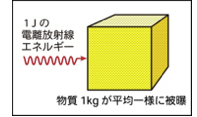
 ICRP学説によれば、吸収線量1Gyは、「物質1kgが1J(ジュール)の電離放射線のエネルギーを吸収した時1Gy(グレイ)とする」と定義しています。(J=ジュールはエネルギーの普遍単位)

つまり1Gyとは、物質1kgが平均に電離放射線のエネルギーを吸収した状態です。

(右イラスト参照のこと)

 そしてICRPは、「吸収線量1Gy」の単位を基にして人体に対する影響の数値単位「Sv(シーベルト)」を創出しています。

 すなわち吸収線量1Gyが、ある臓器や器官に与える影響を、放射線の種類によって区別して算出する「等価線量」、さらに等価線量に臓器荷重係数を考慮して得られる全身に対する影響をあらわす「実効線量」です。

 たとえばX線の放射線係数は「1」とICRPは決めていますから、X線による全身影響は、ICRPによれば、1Gy=1Svの等式が成り立つことになります。

 ここで明確にしなければならないのは、「Sv」の単位には常に1kgあたりという前提が隠れているということです。つまり「1Sv」は常に人体1kgあたり平均した被曝影響を表しているのです。

 ところが内部被曝では、人体1kgあたり平均一様に被曝するなどということは絶対に起こりません。

 判決文がいうように、「放射性微粒子の周囲にホットスポットと呼ばれる集中被曝が生じる不均一被曝」とならざるを得ないのです。

 ここでいう放射性微粒子とは、大きさが「100万分の1m」(ミクロン)単位の大きさです。「1kg」の単位を「マクロの世界」とすれば、放射性微粒子の単位は「ミクロの世界」です。

 マクロの世界では通用する線量体系を、無理矢理ミクロの世界でも通用させようというのが、ICRPの線量体系です。

 低線量の、内部被曝問題に関する限り、ICRP学説の誤りは、そのもともとの線量体系に起因します。

4.ICRP線量体系誤りの再確認

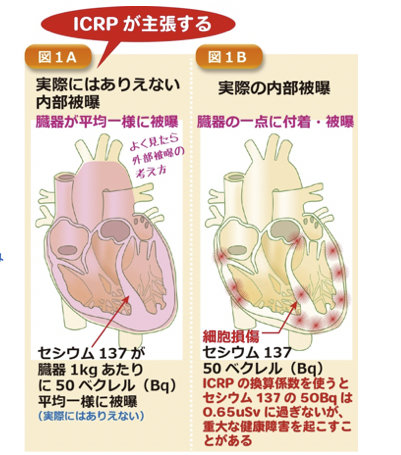
 ここで低線量の、内部被曝に関するICRP線量体系の誤りを再確認しておきましょう。右のイラストを見てください。

図1Aが、ICRP学説が主張する内部被曝のモデルです。「人体1kg」が平均一様に被曝するのですから、この図のようにならざるをえません。(ちなみに成人の心臓は平均800gです)

 これに対して広島地裁判決が指摘する内部被曝が図1Bです。すなわちホットスポットによる「集中被曝による不均一な被曝」です。

 内部被曝による健康影響を考える時、ICRP学説やそれを信奉する国の主張するモデルよりも、広島地裁が指摘するモデルの方がはるかに理に適っており、科学的であることは明らかでしょう。

5.線量体系の不適切さはICRP自身も認める

 ICRP線量体系が、細胞レベル、遺伝子レベルの被曝影響を評価するには、不適切な体系であることは、ほかならぬICRP自身も認めています。

 すなわちICRP線量体系は、巨視的な単位(物質1kgあたり)の被曝影響を評価するには適切だが、微視的な単位(ミクロン、µグラム単位)の被曝影響を評価するには、不適切な線量体系である、しかし今のところ、巨視的な単位の影響評価を行う線量体系しか存在しないので、将来微視的な線量体系ができあがるまで、やむなく巨視的な線量体系を使用する、という趣旨のことをその勧告で明確に述べています。(ICRP1990年勧告。項目番号(17)及び(18))(なおICRP勧告は日本アイソトープ協会のWebサイトで日本語版が無料で公開されています)

ICRPがこの勧告を世に出してから、はや30年以上経過しようとしています。この間、ICRPは現在の巨視的な線量体系に代わって、「ミクロの世界」の被曝影響を評価できる「微視的な線量体系」を策定しようという動きは一切見せていません。そして巨視的な線量体系を、「ミクロの世界」に無理矢理あてはめ続け、低線量被曝、特に内部被曝影響を極端に過小評価し続けているのが現状です。

 読み方によっては、広島地裁判決は、そのICRP学説を根本的に批判している、と読めなくもありません。

6.広島地裁判決の正しさ

 そのほか広島地裁判決は、「バイスタンダー効果」、「ペトカウ効果」や「逆線量率効果」などにも触れ、ICRP学説の低線量被曝影響に関する基礎となる見解を真っ向から否定する知見を認定しています。

「バイスタンダー効果」(傍観者効果)とは、被曝損傷した細胞に異常が起きるばかりではなく、その細胞と通信している別な細胞(バイスタンダー細胞)に異常が発生するという現象です。細胞に対する放射線被曝は、細胞ばかりでなく細胞間通信にも異常を起こさせるという典型的な現象です。「バイスタンダー効果」は「ゲノムの不安定性」と共に医科学界ではすでに常識となっている現象です。ICRPも「バイスタンダー効果」を現象として否定はできず、その勧告でも触れていますが、「バイスタンダー効果の研究はまだ揺籃期である」として事実上、内部被曝要因として無視しています。(ICRP2007年勧告項目番号A28~A31)

「ペトカウ効果」は、「同じ線量ならば、一時的に吸収するよりも長時間(長期間)にわたって吸収する方が影響は大きい」とする効果のことです。

 1972年、カナダ原子力公社のホワイトシェル研究所に勤めるアブラハム・ペトカウ博士が学術誌に公表したもので、ブタの細胞膜に放射線を照射する実験の最中に偶然に発見しました。高い線量の放射線を短時間照射するより、ペトカウの予期に反して、低い線量の放射線を長時間当て続ける方がブタの細胞膜が破壊されやすいことを発見したのです。

 この発見はきわめて重要です。放射線被曝においては、短期間の比較的高線量一時的被曝よりも、極低線量であっても慢性的な長期間被曝の方が健康に対する害は大きい、ことを意味するからです。

 通常の状況にあっても放射能を環境にまき散らさずにはおかない原発など核施設にとって、またチェルノブイリ事故や福島第一原発事故、あるいは軍事用核施設事故など、過酷事故を起こして大量の放射能を環境にまき散らさざるを得ない核施設を抱える核産業は、核施設から同心円状に居住する数多くの住民を、宿命的に慢性的低線量被曝環境におかざるを得ません。

 その核産業にとって、慢性的低線量被曝環境が、人体に害をもたらすという事実を、一般公衆が信じるなどということはおよそあってはならないことです。「ペトカウ効果」は、核産業にとって、またそれを放射線防護の観点から理論的に支えるICRPにとっては、不都合な事実なのです。

 当然ICRPは、「ペトカウ効果」を全面的に否定します。それがICRPの主張する「線量線量率効果」(または単に「線量効果」)です。

「線量線量率効果」は仮説の域を出ませんが、ICRPはそれをあたかも科学的事実であるかのように扱い、「同じ線量ならば、一時期に大量に放射線を吸収する方が、長時間(長期間)にわたって吸収するより効果(影響)は大きい」と主張しています。

 ICRPによれば、100mGy(100mSv)の放射線を一時期に吸収する方が、生涯にわたって、たとえば70年間にわたって吸収するよりも、効果(影響)が大きい、ということになります。

これが「線量線量率効果」(線量効果)です。ICRPの議論はさらに先に進み、その効果はいかほどか、と推測を重ね、2007年勧告ではその係数(線量線量率効果係数)は「2」である、と明記するに至っています。

 これは「ペトカウ効果」とは正反対の結論を導く仮説です。

広島地裁は、事実上「線量線量率効果」を否定し、

「低線量・長時間の方が、一度に大量に被曝したときよりもリスクが高いという逆線量率効果などの知見が存在することが認められる。」(同299頁)

と核産業やICRPにとって極めて都合の悪い事実認定を行っています。

7.不可解な控訴のいきさつ

 控訴をめぐる広島市、広島県及び国の協議は一切非公開なので、新聞報道等に頼るほかはありませんが、国が広島地裁判決を絶対認めない点だけは一貫しています。

 問題はその理由です。当初国の言い分は、「判決にはあらたな科学的知見が認められない」ということでした。これは内閣が政令として定めた「大雨降雨域」を覆すだけの科学的知見がない、という意味でした。

 その後広島市幹部から、「控訴すれば、より多くの「黒い雨」被爆者を救済できる」という意味不明の発言が飛び出します。なぜ控訴することが、より多くの「黒い雨」被爆者を救済することになるのか。それは、

 広島市と広島県が、国と「大雨降雨域」の見直しをするという裏取引が成立したことを意味します。

 しかしそれならば、なおさら控訴の理由がなくなります。国が頑強に控訴にこだわるには別に本当の理由があるはずです。その理由は控訴当日の12日になって判明します。厚労大臣が控訴の理由を、判決は「科学的知見に基づいていない」としたからです。

国が控訴にこだわる理由は、判決の「ICRP学説否定」にあったのです。厚労大臣にとってはこの「ICRP学説否定」が科学的でない、国や核産業にとってはなはだ都合の悪い事実認定であり、なにがなんでも地裁判決をとり消したい、これが控訴の本当の理由であることが、ここにおいて判明したのです。

8.「黒い雨」判決と福島第一原発事故

 「黒い雨」被爆者と福島第一原発事故被害者の間には、一見なんの関連性がないかのように見えます。しかしこの2つは「低線量被曝」、特に「内部被曝」被害者という点でしっかりつながっています。低線量被曝被害発生という点で、1945年8月に日本で起こった大惨事が、2011年3月に寸分変わらぬ形で発生したのです。

 原発など核産業を推進する人々にとっては、「低線量では人体に影響がない」「内部被曝も外部被曝もリスクは同じ」とする言説が、核産業存続の最後の防波堤です。人々が「低線量被曝は安全だ」と信ずればこそ、原発など核産業はこの社会に存続を許されているからです。

 広島地裁判決は、この核産業の「最後の防波堤」に痛烈な一撃を加えました。国は控訴によって広島地裁判決を破棄し、闇に葬りさろうとしている、これが「黒い雨」控訴をめぐる基本構図です。

 被爆地ヒロシマは、あらゆる福島原発事故被害者と連携して、広島地裁判決を守り抜くと同時に、原発など核産業の「最後の防波堤」を突き崩す取り組みをこれからも強めていかなくてはなりません。

以上

Posted in *日本語 | Tagged , , | Comments Off on 「黒い雨」訴訟判決控訴抗議声明via ひだんれん

Press Release: Hazardous dredging started in the Chernobyl Exclusion Zone via Save Polesia

Ukraine takes first steps for the construction of the E40 inland waterway, breaching national law and potentially releasing nuclear waste that could expose millions of people living in Kyiv and between Chernobyl and the capital to increased radiation risk.

  • E40 inland waterway project is a transnational initiative to link the Baltic Sea and Black Sea through a 2,000 km-long navigable connection.
  • Constructing the E40 waterway would have a range of devastating impacts – on people, the global carbon balance and on nature. 
  • Ukraine has started implementation of the project by dredging in the Chernobyl exclusion zone – millions of people could be at increased radiation risk.
  • It is essential that a Strategic Environmental Assessment (SEA) is undertaken to steer an informed, transnational decision on the E40 project. 

[…]

According to an independent scientific study by the French organisation ACRO, 28 million people downstream who depend on the Dnieper River for water and food could be at increased radiation risk if dredging in the Chernobyl exclusion zone continues. Furthermore, Pripyat River and the Kyiv artificial lake will become ongoing sources of radioactive contaminants because annual dredging will be needed to ensure the successful operation of the E40 waterway. This would contaminate the water supply of 8 million people, including the population of Kyiv, while irrigation and the use of dredged soil for agriculture could contaminate crops that 20 million Ukrainians depend upon.

Ariel Brunner, Birdlife International’s Senior Head of Policy for Europe and Central Asia warns that, “digging up radioactive material and sending it down the river into heavily populated areas is irresponsible. Indeed the entire E40 is an ill-conceived and potentially devastating project that is being pushed forward in complete disregard of SEA and EIA legislation.”

The planned E40 waterway is a 2,000 km-long navigable connection to link the Baltic Sea to the Black Sea. A transnational initiative of the Polish, Belarusian and Ukrainian Governments, E40 has been peddled by its proponents as a new commercial highway between the ports of Gdansk, Poland and Kherson, Ukraine, which will attract investments and create new jobs. However, the project’s 2015 feasibility study was incomplete in various respects, including consideration of environmental issues. Public participation has also not been enabled and alternatives to meet the strategic objective of better freight connections between the Black and Baltic Seas have not been adequately explored.

Polesia is Europe’s largest wetland wilderness, encompassing massive carbon sequestering peatlands and crucial habitat for endangered European wildlife. The E40 proposals involve straightening, deepening, damming, and dredging rivers in some of the most sensitive parts of Polesia. These alterations would dramatically change the area’s flood regime. Beyond the threat of radioactive sediments being disturbed and redistributed, the impacts of the E40 waterway will dry up rivers, damage landscapes, negatively impact wildlife, and destroy the livelihoods of local people. The area has huge ecotourism potential, a green development opportunity that would also be undermined should E40 go ahead. Changes to the area’s hydrology could also dry out Polesia’s peatlands, turning an important carbon sink into a serious carbon source.

[…]

Read more.

Posted in *English | Tagged , | Comments Off on Press Release: Hazardous dredging started in the Chernobyl Exclusion Zone via Save Polesia

《団長の思い》原発事故を巡り国と東電に慰謝料を求めた全国最大規模の集団訴訟 9・30控訴審判決 via FNN プライムオンライン

この集団訴訟は、福島県の内外の避難者だけでなく避難していない人も含め3600人を超える被災者が原告となり国と東京電力に原発事故の責任と一律の損害賠償など求めている。(※1人当たり月額5万5000円慰謝料など約280億円)

3年前の一審判決では国と東京電力の責任を認めあわせて5億円の賠償を命じたが、被害が認められたのが原告の一部だけに留まったことなどから控訴していた。

奪われた生活を取り戻すために7年間、原告団の団長として戦ってきた男性は特別な思いで9月30日の判決を待っていた。

<福島県相馬市でスーパーを経営する中島孝さん>

裁判を起こしてから7年、団長として原告団の先頭に立ってきた。

中島孝さん:「放射能が怖い怖くない。早く忘れるのが一番なんだなんていう意見に対するいろんな立場とか、人と人がどうも距離ができてしまったんじゃないか、分断されてしまったんだろうか」

原発事故の後、中島さんが強く感じる【人と地域の分断】。

これまでの裁判では多くの原告が法廷で、そして現地で、生活やコミュニティが奪われたことを自らの言葉で述べてきた。

(略)

中島孝さん:「原発は全然安全ではなかったって国も東電もわかっていたのに、安全対策を本気になって取らなかったというのが今度の事故につながったんだっていうことが(これまでの)裁判の中でもはっきりした。二度とこんなことを起こさないこと。それがこの事故を経験した今の世代の責任だと。私は思っている」

元の故郷を取り戻し、二度と原発事故を繰り返さないために判決の行方を見つめている。

全文は《団長の思い》原発事故を巡り国と東電に慰謝料を求めた全国最大規模の集団訴訟 9・30控訴審判決

Posted in *English | 5 Comments

Four powerful players want a nuclear waste solution. What’s stopping them? via Bulletin of the Atomic Scientists

By David Klaus

The 92-page platform adopted at the Democratic National Convention does not include a single sentence on the issue of how to manage the more than 80,000 tons of spent nuclear fuel sitting at 70 sites in communities across the country. The Republicans adjourned without adopting any new platform for 2020, leaving their 2016 platform in place—but it also did not address the nuclear waste issue.

[…]

The missing coalition. There should be a powerful coalition of diverse interests working to find a permanent disposal path for the thousands of tons of spent nuclear fuel held in temporary storage facilities at commercial nuclear plants across the country. That coalition would include:

  • Utilities with nuclear reactors—many of them permanently closed or closing—that are being forced to build, operate, and secure storage facilities for over 80,000 tons of spent nuclear fuel accumulated over decades of operation;
  • The US government, which has the legal obligation to take back the spent fuel and, per court orders, currently pays in excess of $600 million per year to utilities to store that material;
  • The nuclear industry, which is directly prohibited by state law from building new nuclear plants in eight states until there is an established disposal path for spent nuclear fuel, and is effectively restricted by the waste issue in many other states; and
  • Environmental groups, which are concerned about the safety and security of storing tons of nuclear materials at sites in or near communities across the country.

Such a coalition of diverse interests should be an effective political force. Why hasn’t it produced any results?

The answer is that, notwithstanding their public statements, none of these potential interests really supports addressing the spent fuel issue or is willing to make it a political priority.

[…]

Ultimately, leadership on the issue is going to have to come from a president and congressional leaders who take seriously the US government’s legal obligation to accept commercial spent fuel and build a long-term repository to hold it. This obligation is grounded in nonproliferation policy and was established by statute in the Nuclear Waste Policy Act of 1982.

Oddly, a consensus that the law needs to be changed emerged in the lead-up to the Nevada presidential primary election, when all candidates—including President Trump—announced their opposition to continued development of a long-term repository at Yucca Mountain. Whether that consensus on the need for change evolves into an actual solution will depend on the president who takes office this coming January, and the willingness of the parties that have an institutional interest in finding a solution to look past the reasons they have not done so in the past.

Read more at Four powerful players want a nuclear waste solution. What’s stopping them?

Posted in *English | Tagged , | 9 Comments

愛媛 伊方原発 敷地内の建設現場で火事 放射能漏れはなし via NHK News Web

29日午後、愛媛県伊方町にある伊方原子力発電所の放射線の管理区域の外にある建設現場で火事がありました。火は作業員によってすぐに消し止められ、県によりますと放射能漏れはないということです。

(略)

四国電力によりますと、出火した現場は、国の新たな規制基準に基づいて3号機に設置するテロなどから原子炉格納容器の破損を防ぐ設備などを備えた「特定重大事故等対処施設」の建設現場で、工事中に火花が飛び散り、養生テープの一部が燃えたということです。

火が出た現場は、放射性物質を取り扱う放射線管理区域の外にあり、県は記者会見で、放射能漏れはなく3号機への影響もないと説明しています。

(略)

伊方原発では1号機・2号機の廃炉が決まっているほか、3号機でも運転を停止し、定期検査が行われるなどしていて、現在、稼働中の原発はありません。

全文は愛媛 伊方原発 敷地内の建設現場で火事 放射能漏れはなし

Posted in *日本語 | Tagged , | 5 Comments

Mini nuclear reactors with key South Korean parts cleared by US via Nikkei Asia

Doosan Heavy has struggled as atomic power is phased out

TOKYO —  Miniature nuclear reactors that use key components from South Korea’s Doosan Heavy Industries & Construction have won first-of-its-kind certification for use in the U.S.

The U.S. Nuclear Regulatory Commission in late August approved the use of small reactor modules, or SMRs, for a project being undertaken by the American company NuScale Power in the state of Utah. Doosan agreed to provide NuScale with enough reactor and turbine parts to build a 12-module plant under a $1.3 billion contract.

The project, commissioned by Utah Associated Municipal Power Systems, is due to break ground in 2023 with the plant slated to start up in 2029.

[…]

SMRs are part of a South Korea public-private initiative to export System-integrated Modular Advanced Reactor technology across the globe.

About 650 employees, more than 10% of the total staff, have accepted voluntary retirement packages, and the company has divested mainline businesses, such as a construction and real estate unit, to shore up its financial base.

Japanese and U.S. companies are betting on SMRs as well. A joint venture between Hitachi and General Electric — GE Hitachi Nuclear Energy — is undergoing an NRC safety review for its SMR. Demand is anticipated from the replacement of gas-burning power plants, and adoption of the small reactors in Japan is part of the country’s long-term energy goals.

Mitsubishi Heavy Industries looks to commercialize SMRs in the 2040s. The company is developing units that will work in power plants and onboard ships. Mitsubishi Heavy sees demand from island populations that wish to produce their own power.

Read more at Mini nuclear reactors with key South Korean parts cleared by US

Posted in *English | Tagged , , , | 8 Comments

韓国斗山、小型原発「SMR」で先行 米で認証取得 via 日本経済新聞

韓国の斗山(ドゥサン)重工業が中核部分を担う次世代原子力発電所「小型モジュール原発(SMR)」が米国で設計認証を取得した。米国がSMRに認証を出すのは初めて。原発産業には逆風が吹くが、SMRは安全性が高いとされる。商用化が軌道に乗れば、効率重視で大型化一辺倒だった原発の転機になる可能性がある。

12基1400億円分受注

米ニュースケール・パワーがユタ州公営電力システム(UAMPS)の発注で進めている原発プロジェクトが、米原子力規制委員会(NRC)の設計段階の安全認証を取得した。斗山は出力5万キロワットの小型原子炉やタービンなどの主要機材を12基分納入する。受注金額は13億ドル(約1400億円)規模という。2023年に着工し29年に稼働する計画だ。

斗山のSMRは地下に設けた水槽に原子炉を沈める構造だ。地震などの外部要因で原子炉を冷やす機能が失われるリスクが小さい。主要部分を工場で作り現場では組み立てるだけで済むため、工期が短く初期費用が安く済むメリットもある。出力が小さい分、発電効率は大型原発を下回るが、普及により量産効果が働けば総発電コストは引き下げられるという。

(略)

日米の原子炉メーカーも開発中

SMRには日本勢も期待をかける。日立製作所と米ゼネラル・エレクトリック(GE)が共同出資するGE日立ニュークリア・エナジーも米国での建設を目指し、NRCの安全審査を受けている。ガス火力発電所の建て替え需要などを見込んでおり、長期では日本での展開も視野に入れる。

三菱重工業は2040年代の実用化を目指す。既存技術を生かして発電プラントや船舶などに搭載できるSMRの開発を進める。島しょ部などでの地産地消電源としてのニーズを見据えている。

経済産業省も19年度からSMRなど次世代の原子力技術開発の支援をしている。三菱重工などは国の補助事業の枠組みで実用化に向けた開発を進める方針だ。

(略)

斗山にとっては経営再建に光明が差した格好だ。文在寅(ムン・ジェイン)政権は脱原発を掲げて韓国内での原発新設計画を凍結。斗山は火力発電設備やプラント事業などの低迷も重なり経営危機に陥った。19年まで6期連続の最終赤字が続いており、政府系金融機関から支援を受けて事業売却などを進めている。

従業員の10%超にあたる650人の希望退職実施や、建設会社や不動産など非中核事業の売却を進めて財務基盤の改善を急いできた。今回、1400億円の受注につながるSMRの認証に、資本増強や油圧機器事業の売却契約も重なり、斗山の株価が急騰する場面もあった。SMR関連機材の輸出拡大が実現すれば再建に弾みがつきそうだ。(ソウル=細川幸太郎、東京=川上梓)

燃料処分、残る懸念

東京電力福島第1原子力発電所事故以降、欧米を中心に「原発離れ」の動きが相次いだ。エネルギー安全保障などの観点から原発への投資継続を訴える立場にとって、安全性が高いとされる小型モジュール原発(SMR)は「希望の星」(日本の電力会社)だ。ただ、大量生産が可能で、導入コストが安いことから、核拡散につながるリスクも指摘されている。

全文は韓国斗山、小型原発「SMR」で先行 米で認証取得

Posted in *日本語 | Tagged , | Comments Off on 韓国斗山、小型原発「SMR」で先行 米で認証取得 via 日本経済新聞

Germany launches new search for permanent nuclear waste disposal site via DW

Germany has named 90 locations that could safely house containers of radioactive nuclear waste permanently. The controversy over what to do with waste from the country’s nuclear power plants has been long and divisive.

Germany formally launched its new search for a permanent nuclear waste disposal site on Monday.

BGE, the nation’s waste management organization, named 90 areas around the country as possible candidates for the permanent waste disposal. It said in a long-awaited report that a location needs to be found by 2031. The aim is to start storing containers of radioactive waste at the site by 2050.

Germany is seeking a safe place to store 1,900 containers of waste. The containers make up only 5% of the country’s nuclear waste but 99% of its radioactivity, according to BGE chairman Stefan Studt.

[…]

The plan now is to discuss things step by step with the local communities in the 90 regions shortlisted. That is one reason why the process is scheduled to take so long. Construction is to begin on a new permanent storage facility for nuclear waste in 2031. That’s eleven years from now.

[…]

It’s also hoped that the low-level and intermediate-level waste that was practically dumped in the scandal-ridden mine of Asse for decades can also be moved to permanent storage. Apart from the indiscriminate disposal of nuclear waste, that mine is also in danger of collapsing.  

The German Environment Minister, Svenja Schulze (SPD), welcomed the development. She and 2 state environment ministers co-wrote an opinion piece on Spiegel: “We are confident that this process will enable us to find a location that provides the greatest possible safety and security – not just for the next 50,000 years, rather for a million years or more.” 

If nuclear waste can actually be disposed at the new facility starting 2050, that would still put Germany in the international vanguard: 70 years after humankind began using nuclear energy, not a single permanent waste storage site has been officially opened anywhere in the world.  

Read more at Germany launches new search for permanent nuclear waste disposal site

Posted in *English | Tagged , , , | 5 Comments

福島県、震災公文書の収集基準定めず 一部廃棄の自治体も 問われる伝承館での保管・活用 via 河北新報

東京電力福島第1原発事故の教訓を伝えるため福島県が双葉町に整備した東日本大震災・原子力災害伝承館で、震災関連の公文書の収集基準が決まっていない。全県的な文書管理の議論を先送りにしたまま震災から9年半が過ぎ、本年度に一部を廃棄した避難自治体もある。20日開館した伝承館は資料の保管と活用が役割だが、県は「市町村の公文書に伝承館がどこまで関わるかは議論が必要だ」と腰が重い。

 県は震災関連資料の収集を2017年度に始め、約24万点を集めた。県や市町村の公文書はほぼ対象外としたが、19年3月改訂の資料収集ガイドラインで「引き続き調整し、アーカイブ拠点施設(伝承館)での保管と活用を検討する」などと位置付けた。

(略)

大熊町は全量保管中の公文書の一部を今後、町が整備するアーカイブ施設へ移す。10、11年度は震災前後の業務を比較するため全て残し、12年度以降については震災関連以外は順次廃棄する方針に基づき本年度に選別作業を始めた。

 浪江町は震災関連を含む全ての公文書を規定の年限で廃棄している。震災前後の公文書は「歴史的な価値判断がつかない」として休校中の浪江小に仮置きしていたが、今夏に校舎の解体工事が始まったため保健師の仮設住宅巡回記録などを廃棄した。

 こうした公文書を伝承館が直接保管することは確かに「収蔵スペースなどの問題から現実的でない」(同館関係者)。ただ、伝承館開館は今後の活用を踏まえた保管の在り方を問い直す好機でもある。

全文は福島県、震災公文書の収集基準定めず 一部廃棄の自治体も 問われる伝承館での保管・活用

Posted in *日本語 | Tagged , | 5 Comments