Has Kazakhstan forgotten about its Polygon test survivors via PRI’s The World

On a bright, bitterly cold day in early November, Aigul Suleimenova went home during her lunch break to check up on her daughter, Assee, who has a condition that weakens her nervous system.

“She was born like that,” Aigul said. Assee, now 29, spends her days in a wheelchair and is under constant supervision.  

The Suleimenovas live in the industrial city of Semey in eastern Kazakhstan, home to several food-processing and textiles factories. Aigul works as a security guard at a bread factory.

Many of Semey’s residents, like Assee, are disabled or suffer chronic illnesses. When Aigul brings her daughter to social events for disabled children, she notices that those who have lived in Semey or nearby villages in eastern Kazakhstan have health issues that all seem to point to a single cause — the Polygon. 

In the nuclear arms race against the United States, the former Soviet Union performed more than 450 nuclear tests in an area known as the Semipalatinsk Test Site — otherwise known as the Polygon — from 1949 to 1989. Although the test site itself was uninhabited, winds blew the nuclear fallout and radioactive dust into neighboring villages, affecting anywhere between 500,000 to 1 million people.

Some died immediately from the exposure to nuclear fallout, though the exact number is unknown. Exposed women of childbearing age gave birth to children with physical deformities and other neurological defects. Adults developed a range of fatal cancers. 

Related: Soviet-era nuclear testing is still making people sick in Kazakhstan

The Polygon shut down in 1991, the same year that Kazakhstan gained independence from the former Soviet Union. Nursultan Nazarbayev, who has served as Kazakhstan’s president since then, seemed eager to move the country away from its nuclear history. He decreed the permanent closure of the test site and asked more than a dozen civilian and military experts to devise a cleanup and conversion plan. 

The following year, in 1992, the government sought to help families who were exposed to the Polygon tests. Government officials traveled to villages close to the test sites and handed out ‘‘radiation passports.”

A blueish-purple mushroom cloud decorates the front of the passport. The small, beige documents were issued based on where villagers resided, and whether or not they were exposed to significant levels of nuclear radiation. Asee Suleimenova, along with others born at that time, were all issued such documents.

The government officially recognized 1,323,000 people as being negatively affected by these nuclear tests but only 1,057,000 received radiation passports. By law, those with passports were entitled to compensation and other social benefits — such as higher pensions and additional paid holidays; children under 18 were entitled to free healthcare — based on their individual health conditions.

From 2003 to 2017, approximately $30.5 million was paid out to more than 700,000 individuals with radiation passports. All told, this comes to about $40 a year per individual. 

Many first-generation Polygon survivors said the law worked in their favor at first. But as Kazakhstan moves further away from its nuclear past, survivors and their descendants can’t help but wonder: has the government forgotten about them?

[…]

Related: Kazakhstan cafe uses employment to fight disability stigma

One generation after another

Nuclear radiation damages DNA, the building blocks of genes — researchers say that some health conditions caused as a result of the nuclear fallout might be passed down from generation to another. 

To receive social support from the state, one must have a radiation passport. But the government stopped issuing radiation passports after 1992, which means the passport program excludes children who have been born to affected families since then. 

Now, some families that were affected by the nuclear tests are giving birth to a fifth generation, says Talgat Muldagaliev, deputy director of science and research at the Institute of Radiation Medicine and Ecology. Now that research has slowly emerged proving that some health conditions have a genetic basis, “we expect that laws for social protections will be revised and amended so that all generations of people who could have possibly been affected by these nuclear tests will receive better social support,” Muldagaliev said. 

Olga Petrovskaya, the chair of Generation, a Semey-based nongovernmental organization founded in 1999, also hopes the government will begin to pay attention to Polygon test survivors after years of neglect. She and members of Generation are working to petition the Kazakhstan government for increased social protection because they believe the law initially set in 1992 is no longer benefiting them. 

“It was good for the first two years, but then the benefits started going away,” says Petrovskaya.

Kazakhstan’s turbulent economic situation as it transitioned in the 1990s may explain why the government was unable to fulfill its obligations to provide compensation to those affected by the nuclear tests. 

[…]

Read more.
Posted in *English | Tagged , , | Comments Off on Has Kazakhstan forgotten about its Polygon test survivors via PRI’s The World

トリチウムの健康被害について via 市民のためのがん治療の会

顧問 西尾 正道

●はじめに

[…] 有識者は足かけ6年にわたりトリチウムを含んだ処理水の処分策について検討してきたが、その結論として5つの処分方法を提示した。 その処分方法別の費用は34億円~3976億円と大きな幅があるが、結論としては最も安い費用で済む海洋放出(費用34億円)を行おうとしている。 この方針は東電会長ばかりではなく、原子力規制委員会の更田豊志委員長も「希釈して海洋放出が現実的な唯一の選択肢」と記者会見で述べ、寄生委員会化している。

[…]

公聴会の資料では「トリチウムは自然界にも存在し、全国の原発で40年以上排出されているが健康への影響は確認されていない」と安全性を強調し、 また「トリチウムはエネルギーが低く人体影響はない」と安全神話を振りまいています。 しかし、世界各地の原発や核処理施設の周辺地域では事故を起こさなくても、稼働させるだけで周辺住民の子供たちを中心に健康被害が報告されている。 その原因の一つはトリチウムと考えられるが、本稿ではそのトリチウムの危険性を論じる。

[…]

●トリチウム【tritium】(記号:T)とは

[…]

問題なのは、原子力発電では事故を起こさなくても稼働させるだけで、原子炉内の二重水素が中性子捕獲によりトリチウム水が生成され、膨大なトリチウムを出すことです。 トリチウムはβ崩壊して弱いエネルギーのβ線を出してヘリウム3(3He)に変わります。 β線の最大エネルギーは18.6keV、平均エネルギーは5.7keVで物理学的半減期は12.3年です。 体内での飛程0.01mm(10μm)ほどです。このため原子力政策を推進する人達はエネルギーが低いので心配ないとその深刻さを隠蔽し、海に垂れ流しています。 人間の体内では、水素と酸素は5.7eVで結合し水になっています。 トリチウムの平均エネルギーは5.7KeVであり、その1000倍以上のエネルギーです。

[…]

 経口摂取したトリチウム水は尿や汗として体外に排出されるので、生物学的半減期が約10日前後であるとされています。 また気体としてトリチウム水蒸気を含む空気を呼吸することによって肺に取り込まれた場合は、そのほとんどは血液中に入り細胞に移行し、体液中にもほぼ均等に分布します。 問題なのは、トリチウムは水素と同じ化学的性質を持つため体内では主要な化合物である蛋白質、糖、脂肪などの有機物にも結合し、 化学構造式の中に水素として組み込まれ、有機結合型トリチウム(OBT:Organically Bound Tritium)となり、トリチウム水とは異なった挙動をとります。 この場合は一般に排泄が遅く、結合したものによってトリチウム水よりも20~50倍も長いとする報告もあります。 有機結合型トリチウム(OBT)の体内蓄積のパターンの一つは原⼦⼒施設から出るトリチウム⽔の⽔蒸気によって汚染された⼟地で育った野菜や穀物ばかりでなく生物濃縮した⿂介類などの⾷物を摂取することであり、 もう一つはトリチウム⽔の飲食や吸入などによって、⼈体が必要とする有機分⼦の中にトリチウムを新陳代謝して摂り込みます。 なお放射線の生物学的効果を表すRBE(Relative Biological Effectiveness,生物学的効果比)は、γ線は1であるが、トリチウムのβ線は1ではなく、1~2の間という報告が多く、より影響が強いと考えられます。

●トリチウムの人体影響

[…]

 放射線の影響は基本的には被曝した部位に現れます。 エネルギーが低くても水素として細胞内の核に取り込まれ、そこで放射線を出して全エネルギーを放出するわけですから影響が無いことはないのです。 有機結合型トリチウムは結合する相手により体内の残留期間も異なります。 図1に人体影響のポイントをまとめて示しますが、トリチウムは他の放射性核種と違って、放射線を出すだけではなく化学構造式も変えてしまうのです

[…]

内部被曝による人体影響はマンハッタン計画以来、軍事機密とされ隠蔽され続けており、トリチウムもそのひとつなのです。 トリチウムがほとんど無害とされ、極端な過⼩評価をされてきたのは、ICRP(国際放射線防護委員会)の線量係数の設定によります。 内部被曝を計算する「実効線量換算係数」は放射性物質1Bqが⼈体全体に与える影響度の単位(Sv)に換算する「係数」のことですが、 1Bq という測定可能な物理量を「⼈体全体に与える影響度」などという「仮定量」に換算するという話⾃体が詐欺的な疑似科学です。 

[…]

●原発稼働による健康被害の報告

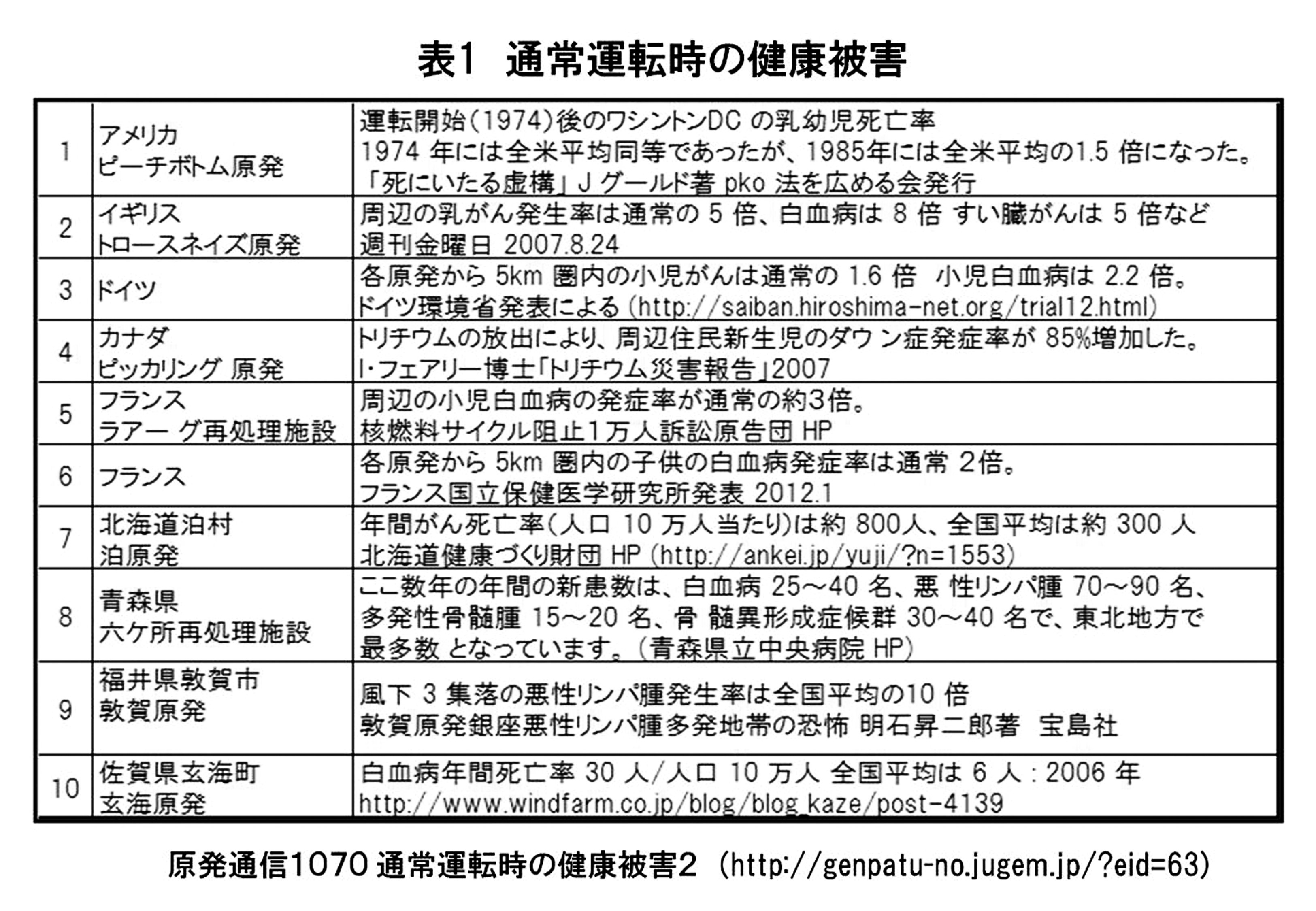
1945年の原爆投下から始まった環境へ放出され続けている人工放射性物質との出会いは人類にとって初めて経験する負の世界です。 特に戦後の大気中核実験による核分裂で生じた放射性物質は土壌と海洋汚染をもたらし、我々は無意識のうちに体内に多かれ少なかれ放射性物質を取り入れているのです。 ただ測定していないだけなのです。原発通信が最近まとめた日本を含む世界各地の原発周辺地域の健康被害の報告を表1に示します。


表1 原発は通常運転時でも住民に健康被害を及ぼす

資料:原発通信1070 通常運転時の健康被害2(http://genpatu-no.jugem.jp/?eid=63)
[…]


Posted in *日本語 | Tagged , , , , | Comments Off on トリチウムの健康被害について via 市民のためのがん治療の会

月110時間を超える長時間労働で過労死認定――忘れられつつある福島第一原発で今も働く作業員の実態 via 週プレNews

■未明から暗くなるまでの長時間労働だった

「残業代も払ってもらえずに働き、夫は汗まみれのままで亡くなりました。二度と夫のような過労死が起きないようにしてほしいと思います」

亡くなった猪狩忠昭さん(当時57歳)の妻は11月7日、夫の労災認定を発表した記者会見で涙をふきながらこう話した。

福島第一原発では今も、毎日約5000人の作業員が働いている。汚染水や核燃料の取り出しなどの課題が指摘される一方で、東電は作業環境が改善したことを強くアピール。そうしたなかでの過労死だった。原発事故後、長時間労働での過労死認定は初めてとみられる。

[…]

その後、17年に東電は、原発構内で使う全車両に通常の車検並みの点検を18年9月までに実施すると発表。それに伴って、猪狩さんは月~金曜日は原発、土曜日は会社で車両整備をする生活になった。

原発に向かう日は、午前4時半に会社の事務所でタイムカードを押し、一般道を1、2時間かけて通勤。防護服に着替えてミーティングをし、午前8時過ぎには整備場で作業を始めた。帰りは事務所に戻って事務作業や残った整備をし、退社するのは午後6時から7時だったという。

作業環境も厳しいものだった。何しろ原発構内の車は放射能汚染がひどい。そのため全面マスクに防護服、二重の手袋という重装備。猪狩さんは、整備の手間がかかる大型車や消防車のような特殊車両を担当していた。

そうした状況を遺族が知ったのは、猪狩さんが亡くなった後だ。妻は言う。

「最初の2年くらいは原発に行っていることも知らなかったんです。その後、朝早くなることが増えたときに大丈夫かと聞いたら、朝が早い分お昼の休憩が長くて仮眠も取れるから大丈夫だよって。安心させたかったのでしょう」

実際は、休憩所に行くには放射能汚染のチェックをしたり防護服を着替える必要があるため、昼は1時間も休めなかった。

妻は、猪狩さんの整備士仲間からこんな話も聞いている。

「その方は『普通はあんな車は直さない。オレなら放り出しちゃう。でもあいつはできるからやっちゃうんだ』って言ってました。夫はその人に『オレがやるしかないんだ』って話していたそうです。そこまで責任感を持って仕事してたんだなって思いました」

■東電と会社の冷たい対応に不信感が増した

猪狩さんは亡くなる1年前に心臓の血管の手術を受けている。手術はうまくいき体調もよかったが、亡くなる1ヵ月くらい前から体がつらいと不調を訴えるようになった。同僚は、亡くなる3日ほど前、階段の上り下りもつらそうだった猪狩さんを見たという。

「作業前には毎日、血圧や体温を測って記録していました。血圧が高かったのは会社も知っていたはずです」と妻は言う。

[…]

「後で東電の記者会見のことを知ってびっくりしました。『病死』って発表した時間、私は夫の亡骸(なきがら)にも会っていなかったんです。それに東電は『ご家族の皆さまにお悔やみを申し上げます』と言っていましたが、今でも直接何かを言われたことはありません」

東電と雇い主のこうした対応に不信感を募らせた遺族は、「フクシマ原発労働者相談センター」などの協力を得ながら情報を集めた。そしてタイムカードの記録から月平均110時間を超える残業があったことを突き止め、今年3月、いわき労働基準監督署に労災を申請したのだ。

申請が認められたのは一周忌直前の10月16日。妻は記者会見で、「夫のがんばりを認めてもらい、ほっとしています。夫のお墓に『お疲れさまでした』と伝えました」と話し、声を詰まらせた。

いわきオールは週刊プレイボーイの取材に対して代理人弁護士を通し、「適切な労務管理・従業員の健康管理を行なっていたと認識しております」と回答。東電は記者会見で、「これからも安全最優先で環境整備をしながら、しっかり(作業を)進めていきたい」とだけ述べた。

原発事故から7年半が経過し、東電や政府はしきりに福島第一原発の労働環境が改善したことを強調している。本当に変わったのだろうか。『週刊プレイボーイ』49号(11月19日発売)では、福島第一原発で働く現場の生の声もレポート、彼らが今抱える不安を伝えている。


全文

Posted in *日本語 | Tagged , , , | Comments Off on 月110時間を超える長時間労働で過労死認定――忘れられつつある福島第一原発で今も働く作業員の実態 via 週プレNews

めおと漫才トークライブ「福島原発事故とその後」 12/22に高知市 via 高知新聞

吉本興業のめおと漫才コンビ「おしどりマコ&ケン」によるトークライブ「ニュースが伝えない福島原発事故とその後」が22日、高知市旭町3丁目のこうち男女共同参画センター「ソーレ」で開かれる。原発をなくし、自然エネルギーを推進する高知県民連絡会の主催。

(略)

原発事故後の政府などによる「直ちに健康に影響はない」との説明に違和感を覚え、東京電力の会見や、学会などの取材活動を開始。第22回平和・協同ジャーナリスト基金奨励賞を受賞した。

午後2時から4時半。千円(当日1200円)、大学生千円、高校生以下無料。高新プレイガイドなどで販売中。問い合わせ先は平和運動センター(088・875・7274)。

全文はめおと漫才トークライブ「福島原発事故とその後」 12/22に高知市 

Posted in *日本語 | Tagged , , | Comments Off on めおと漫才トークライブ「福島原発事故とその後」 12/22に高知市 via 高知新聞

Edison’s Plans To Resume Nuclear Waste Transfer May Face Legal Challenge via KPBS

Southern California Edison may face more legal challenges before resuming the transfer of highly radioactive spent fuel rods from cooling ponds to silos near the beach at San Onofre.

San Diego attorney Mike Aguirre said Edison has not lived up to the terms of a settlement agreement he reached with them last year. Aguirre had challenged the California Coastal Commission’s permit allowing Edison to bury the waste 100 feet from the ocean. He reached a settlement with Edison and the California Coastal Commission, in which Aguirre said Edison agreed to make every “commercially reasonable effort” to find an alternative place to store the nuclear waste.

Instead, Aguirre said, half-inch thick stainless steel canisters holding the waste may have been damaged during transfer, making future relocation more difficult or impossible. He cited a Nuclear Regulatory Commission report released last month that summarizes management problems at the plant, including lack of training, of equipment, of safety procedures and oversight, that resulted in a near-miss accident at San Onofre.

[…]

Edison Public Information Officer John Dobken said operations to move the spent fuel rods from cooling ponds to buried silos will not resume until the NRC has inspected revamped procedures. He said the company hopes to continue loading the canisters packed with spent fuel into bunkers in mid to late January.

Read more at Edison’s Plans To Resume Nuclear Waste Transfer May Face Legal Challenge 

Posted in *English | Tagged , , , , | Comments Off on Edison’s Plans To Resume Nuclear Waste Transfer May Face Legal Challenge via KPBS

Mayor confirms ‘loans,’ denies ties to nuclear waste site via The Asahi Shimbun

MINAMI-OSUMI, Kagoshima Prefecture–The mayor here received 8 million yen ($71,500) in unreported “loans” but returned the money apparently after lenders complained he wasn’t following through on promises to bring a nuclear waste disposal site to the town.

Toshihiko Morita, 59, told a news conference on Dec. 20 that he accepted a total of 10 million yen from four people over two occasions before the mayoral election in April 2009.

But he emphasized that the money was “personal loans” for his business and had nothing to do with his political activities.

[…]

Morita denied any relation between the money he received and the letter of proxy.

The three individuals said that in October 2017, they demanded Morita return their money, citing no progress in courting the nuclear waste facility.

The following month, Morita repaid the 8 million yen.

It was not clear if the mayor repaid the additional 2 million yen, nor the identity of the person who provided that money.

[…]

An official in charge of Morita’s campaign told The Asahi Shimbun that the money was accepted as a “campaign fund.” But Morita’s election campaign income and expenditure report did not list the sum, a possible violation of the Public Offices Election Law.

That campaign report was destroyed after the expiration of the three-year preservation period set by the town.

[…]

In a report released in July 2017, the Ministry of Economy, Trade and Industry, which oversees the nuclear industry, described potential candidate sites across the country based on geological and other factors. The report said most of the land in Minami-Osumi is “favorable” as a location for a dumping ground.

The town, with a population of nearly 7,300 on the southern tip of the main island of Kyushu, considered hosting a final disposal site in 2007, when Morita’s predecessor was in office.

Morita said he will continue to oppose the hosting of the radioactive waste disposal site.

Read more at Mayor confirms ‘loans,’ denies ties to nuclear waste site 

Posted in *English | Tagged , | Comments Off on Mayor confirms ‘loans,’ denies ties to nuclear waste site via The Asahi Shimbun

福島県が「心筋梗塞」「脳卒中」患者調査へ 1月から発症登録 via 福島民友

県で死亡率が高い急性心筋梗塞と脳卒中の発症状況の調査を検討していた県は19日、来年1月から発症登録事業を始めると発表した。県内に住民登録されている人のうち、1月1日以降に急性心筋梗塞や脳卒中を発症した人を調査する。

医療機関に登録票を配布し、発症した患者の情報を福島医大健康増進センターで集約する。

(略)

厚生労働省の年齢調整死亡率(2015年)によると、本県の急性心筋梗塞の死亡率は男女とも全国ワースト1位。脳梗塞の年齢調整死亡率は男性が全国ワースト7位、女性が同5位と悪化が目立っている。

全文は福島県が「心筋梗塞」「脳卒中」患者調査へ 1月から発症登録

Posted in *日本語 | Tagged , , | 1 Comment

東海第2原発で作業員死亡 放射線管理区域外で感電か via The Sankei News

18日午後3時半ごろ、茨城県東海村の日本原子力発電東海第2原発で、点検作業中だった同県那珂市菅谷の会社員、宇野貴則さん(43)が倒れているのが見つかり、搬送先の病院で死亡が確認された。作業していたのは放射線管理区域外で、感電したとみられる。

原電によると、宇野さんは原電の協力会社の社員。送電線と発電所を接続する機器がある「屋内開閉所」付近で倒れているのを、一緒に作業をしていた同僚が発見した。

続きは東海第2原発で作業員死亡 放射線管理区域外で感電か 

Posted in *日本語 | Tagged , , | Comments Off on 東海第2原発で作業員死亡 放射線管理区域外で感電か via The Sankei News

Another outage at nuclear power plant in Mississippi raises concerns via CBS News

Jackson, Miss. — Another unplanned outage at Mississippi’s Grand Gulf nuclear power plant is adding to regulators’ concerns that reliability problems at the largest single-unit nuclear power plant in the United States may be affecting power markets.

Operators at the Entergy Corp. plant in southwest Mississippi took it offline Wednesday, citing problems with a turbine bypass valve. The outage came to light Tuesday when the federal Nuclear Regulatory Commission (NRC) announced a special inspection citing equipment issues “the agency wants to better understand.”

[…]

The plant has been running at reduced or zero power output for much of the time since 2016. That can stress power supplies and cause higher prices across Mississippi, Arkansas, Louisiana and eastern Texas. Tuesday, the commission said Grand Gulf was running at 18 percent power.

Read more at Another outage at nuclear power plant in Mississippi raises concerns

Posted in *English | Tagged , , | 1 Comment

泊原発の保安規定違反認定 非常用発電機の接続不良 via 福井新聞

原子力規制委員会は19日の定例会合で、停止中の北海道電力泊原発(泊村)の非常用ディーゼル発電機1台が11月の試運転で起動しなかった問題について、原発の運用ルールを定めた保安規定の違反に当たると認定した。

(略)

非常用発電機は外部電源が失われた場合でも原発の冷却機能を維持するための重要設備。外部電源を喪失した今年9月の大規模地震の際は、3号機に2台あるうちの接続不良の1台も起動し、計6台で使用済み核燃料プールの冷却を続けた。

全文は泊原発の保安規定違反認定 非常用発電機の接続不良

Posted in *日本語 | Tagged , | 1 Comment