<福島第1原発事故>公務員宿舎未退居の自主避難者に2倍家賃 知事「契約に基づく」via 河北新報

国家公務員宿舎に居続ける東京電力福島第1原発事故の自主避難者に、福島県が損害金の支払いを求める請求書を送付した問題で、内堀雅雄知事は16日の定例記者会見で、請求は避難者との契約に基づいて実施したとの考えを示した。

内堀知事は宿舎の入居に関し「2年間の経過措置として貸し付けた」と強調。3月に措置期限を迎えたことを踏まえ「契約に基づき4月分の請求を行った」と述べた。生活保護受給世帯には請求しない措置を講じたことも説明し「今後も未退居世帯には丁寧な対応をとる」と語った。

県は自主避難者への住宅無償提供を2017年3月末で打ち切り、宿舎入居世帯には一定の家賃支払いを条件に2年間の延長を認めた。19年4月以降は、退居まで家賃の2倍の損害金を支払う契約になっている。
続きは<福島第1原発事故>公務員宿舎未退居の自主避難者に2倍家賃 知事「契約に基づく」

Posted in *日本語 | Tagged | 3 Comments

NRC eyes reducing inspections of nuclear reactors via The Hill

BY JOHN BOWDEN – 07/17/19 07:14 AM EDT

Nuclear Regulatory Commission (NRC) officials have reportedly recommended the agency cut back on inspections of U.S. reactors as a cost-cutting measure.

The Associated Press reported Wednesday that NRC officials said that the move would maintain adequate safety measures while allowing the NRC to meet budgetary constraints. The decision was reportedly controversial, however, with some arguing that it exposed the public to unnecessary risk.

This cost-cutting measure “improves efficiency while still helping to ensure reasonable assurance of adequate protection to the public,” the NRC said Tuesday in a report, according to the AP.

“NRC shouldn’t perform fewer inspections or weaken its safety oversight to save money,” countered commission member Jeff Baran, according to the news service.

[…]

According to the AP, the measure would reduce the time and scope of some inspections while reducing the frequency of others from every two to every three years.

House Democrats led by Energy Committee Chairman Frank Pallone (D-N.J.) reportedly urged officials to reconsider the changes in a letter.

“Cutting corners on such critical safety measures may eventually lead to a disaster that could be detrimental to the future of the domestic nuclear industry,” the Democrats wrote on Monday.

Read more at NRC eyes reducing inspections of nuclear reactors

Posted in *English | Tagged , | Comments Off on NRC eyes reducing inspections of nuclear reactors via The Hill

福島第一原発事故を描く『Fukushima50』、緊迫の撮影現場を映した初映像解禁 via Exciteニュース

俳優の佐藤浩市が主演し、渡辺謙が共演する、東日本大震災時の福島第一原発事故を描く映画『Fukushima 50』より、佐藤と渡辺のコメントとメイキング、本編カットを合わせた特別映像が到着した。

本作は、ジャーナリストの門田隆将が90人以上の関係者への取材を元につづったノンフィクション『死の淵を見た男 吉田昌郎と福島第一原発』(角川文庫)を原作にした人間ドラマ。2011年3月11日午後2時46分、日本観測史上最大の地震によって引き起こされた巨大津波に襲われ、未曾有の事故に苛まれた福島第一原子力発電所を舞台に、事故後も発電所に残り、事態収束のために奔走した約50名の作業員の戦いを描く

(略)

解禁された特別映像は、メインキャストの姿を中心に、緊迫した撮影現場が映し出され、スタッフ・キャスト陣の作品へ向かい合う“緊張”と“本気”が伝わる熱量を帯びた映像に仕上がっている。

 映像の中で佐藤は「忘れなければ生きて行けないことと、絶対に忘れてはいけないこと、その2つが、生きていく上で大変大事な事だと思っています」と思いを語り、渡辺は「単純に映画を創るという以上のいい意味での緊張感があります」とコメントしている。
 映画『Fukushima 50』は2020年3月より全国公開。

全文は福島第一原発事故を描く『Fukushima50』、緊迫の撮影現場を映した初映像解禁

Posted in *日本語 | Tagged | 3 Comments

チェルノブイリの国ウクライナが原発を使い続ける理由 via 朝日新聞 Globe+

[…]

ゼレンスキー大統領は、「これまでチェルノブイリはウクライナのイメージの負の側面だった。我が国の問題を、優位へと転換する時が来た。ここは自然が再生している地球上でも稀有な土地であり、世界の学者、環境専門家、歴史家、旅行者たちに、それを見せてあげる必要がある。チェルノブイリ・ゾーンを新たなウクライナの成長拠点の一つにしたい。これまでゾーンへの入域が利権と化し、腐敗の温床となっていたが、自由化することでその余地もなくなる。ゾーンからの金属スクラップの違法な持ち出し、天然資源の勝手な利用なども防止できる」と、新機軸の狙いを説明しています。

[…]

実はウクライナは今日でも原発ヘビーユーザー

ところで、日本人の感覚からすると、ウクライナの新任大統領が初めてチェルノブイリを訪れたわけですから、この機会に、今後の原子力政策について方針や見解を述べてもよさそうなものです。しかし、筆者が調べた限りでは、ゼレンスキー大統領はそういったことには触れず、ひたすらチェルノブイリ・ゾーン活用についてだけコメントしたようです。

それもそのはずであり、実はウクライナは今日も原子力発電に深く依存しているのです。さすがにチェルノブイリ原発での発電は2000年に停止されましたが、それ以外の4箇所の原発で15の原子炉が稼働しています。ウクライナの政財界のエリートで、「脱原発」を唱えるような向きは稀であり、それを求める社会運動なども目立ちません。近年の選挙で争点になったこともないと思います。ゼレンスキー新大統領にしても、原発の維持を当然のものと受け止めているでしょう。

ちなみに、1986年の大惨事で汚染を被ったのはウクライナだけでなく、ロシアとベラルーシも深刻な汚染にさらされました。実は、最大の被害国はベラルーシであり、汚染物質の70%以上がベラルーシに降り注いだと言われています。皮肉なことに、この3国とも、現在は原発推進国と位置付けられます。

[…]

全文

Posted in *日本語 | Tagged , , | 3 Comments

Yamamoto Taro: New Prospects for Progressive Politics in Japan via Foreign Policy in Focus

[…]

One of the most impressive of this new generation, who is currently touring Tokyo to give speeches in the lead-up to the July 21 elections, is the charismatic and committed Yamamoto Taro.

A long-time critic of the government’s denial of environmental damage resulting from the Fukushima nuclear disaster, he has openly advocated on behalf of the citizens of the region who suffer from high rates of cancer. Yamamoto made headlines when he handed the previous emperor, Akihito, a letter in 2013 describing the terrible health conditions of children living around the disabled nuclear plant and the workers involved in the cleanup. Mainstream politicians attacked him for trying to use the emperor for political purposes at a public event, and many demanded that he resign and that be barred from future such events.

Yamamoto’s willingness to talk about the details of daily life for those confronted with the fallout of the nuclear disaster – in spite of the virtual media blackout on the issue – won him a small but devoted base in Japan.

Yamamoto started his career as an actor and established himself as a “talent,” a popular figure who appears on late-night talk shows to discuss current affairs and culture in a lighthearted manner. He took up the anti-nuclear issue after the meltdown at the Fukushima Daiichi reactor caused by the March 11, 2011 earthquake. To the detriment of his acting career, Yamamoto threw himself into activism, promoting renewable energy and working with those whose health was effected by the disaster.

[…]

A New Party

Yamamoto broke his primary affiliation with Jiyuto (Freedom Party) in April 2019 and launched a new political coalition known as Reiwa Sinsengumi. The Reiwa Sinsengumi (Reiwa New Election Team) coalition has fielded multiple candidates for the current elections (including Yamamoto) and has taken forceful positions not found among other established opposition parties. For example, Reiwa Rinsengumi demands an immediate end to the regressive consumption tax (other opposition parties only ask that the rate not be raised), has openly opposed the construction of the Henoko Base in Okinawa, has demanded an immediate and unconditional end to nuclear power in Japan, and has proposed a 1500-yen-an-hour minimum wage.

[…]

Read more.

Posted in *English | Tagged , , | Comments Off on Yamamoto Taro: New Prospects for Progressive Politics in Japan via Foreign Policy in Focus

Radiation in parts of the Marshall Islands is far higher than Chernobyl, study says via Los Angeles Times

By SUSANNE RUST
JUL 15, 2019 | 12:00 PM 

Think of the most radioactive landscapes on the planet and the names Chernobyl and Fukushima may come to mind.

Yet research published Monday suggests that parts of the Marshall Islands in the central Pacific, where the United States conducted 67 nuclear tests during the Cold War, should be added to the list.

In a peer-reviewed study, Columbia University researchers report that soil on four isles of the Marshall Islands contains concentrations of nuclear isotopes that greatly exceed those found near the Chernobyl and Fukushima nuclear power plants. On one isle, those levels are reported to be 1,000 times higher.

[…]

Researchers found concentrations of plutonium-238 on Naen, raising the possibility that the island was used as an unreported dumping ground. Plutonium-238 is a radioisotope associated with nuclear waste and not generally with fallout, said Ivana Nikolic Hughes, a co-author of the research and an associate professor of chemistry at Columbia.

The only other place the team detected this isotope was at Runit, where the United States entombed nuclear waste from bomb testing under a leaking concrete dome.

“We can’t say for sure that [dumping on Naen] is what happened,” said Nikolic Hughes, who directs Columbia’s K=1 Project — a multidisciplinary program dedicated to educating the public about nuclear technology. “But people should not be living on Rongelap until this is addressed.”

[…]

Some researchers have declared Rongelap safe for re-habitation. But the Columbia study suggests that, for now, people not return to Rongelap or Bikini atolls, where Naen and Bikini are located, until certain areas have been more thoroughly cleaned. More than 600 people have already returned to parts of Enewetak atoll — where Runit and Enjebi are located.

“We are concerned about what is being consumed on Naen and at what level,” said James Matayoshi, the mayor of Rongelap Atoll. He said he didn’t like the idea of people collecting food from Naen and the islands near it, because he doesn’t know what kind of risk that poses for his constituents’ health.

[…]

For years the U.S. government, with technological help from the Department of Energy’s Lawrence Livermore National Laboratory, has worked to reduce radiation on Rongelap Island — removing soil from around the village and applying potassium to areas where food is grown, which works to prevent plants from taking up radiation.

People can be exposed to radiation by inhaling dust or drinking contaminated water, but studies have found that food is the primary way Marshall Islanders are exposed to radiation — even if background and soil radiation are relatively low.

In 1992, the United States and the Republic of the Marshall Islands entered into a memorandum of understanding that stipulated Rongelap Atoll, which was evacuated in 1954 and again in 1985, could only be resettled when radiation exposure levels — all sources of exposure — fell below 100 millirem per year. That standard, noted Nikolic Hughes, is much less stringent than standards in the United States — where the EPA established a limit of 15 millirem per year for the general population living near the proposed Yucca Mountain nuclear waste repository, for the first 10,000 years.

[…]

The comparisons in the studies being released Monday — including findings that plutonium levels in parts of the Marshall Islands are 15 to 1,000 times higher to those sampled near the Chernobyl and Fukushima power plants — are sure to raise eyebrows.

But the study’s authors note there’s one big difference between the Marshall Islands and other high-profile contaminated sites. At Chernobyl and Fukushima, there are active government efforts to keep people away from the contaminated reactors, whereas islands such as Bikini and Naen are easily accessible by the Marshallese, who traditionally have boated from island to island to collect fruits and other food.

“The Marshallese people deserve an independent assessment from experts on the safety of their islands, starting from collecting raw data all the way to the final analysis and conclusions,” said Hughes, lamenting that even his work could be seen as suspect by Marshall Islanders.
“It would be ideal,” he said, “if there were no U.S. citizens doing this independent study.”

Reporting for this article was funded in part by the Investigative Reporting Resource at the Columbia Journalism School. 

Read more at Radiation in parts of the Marshall Islands is far higher than Chernobyl, study says

Posted in *English | Tagged , , | 3 Comments

原発避難、今も苦しむ シンポで当事者ら訴え 福島 via 河北新報

東京電力福島第1原発事故の被災地の現状を報告する「福島を忘れない! 全国シンポジウム」が13日、福島市であった。避難を強いられた福島県内の被災市町村の議員や集団訴訟の原告らが、脱原発を訴えるなどした。

県内外から約120人が参加。福島県南相馬市小高区から横浜市へ避難した福島原発かながわ訴訟原告団の村田弘団長(76)は「関連死や健康被害を訴える人がたくさんいる。原発事故はまだ終わっていないということを発信し続けなければならない」と呼び掛けた。

川内、浪江、葛尾、飯舘4町村の議員も登壇し、避難指示解除後の帰還状況などを説明。

(略)

元京都大原子炉実験所助教の小出裕章氏による講演もあった。シンポは今年で7回目。

全文は原発避難、今も苦しむ シンポで当事者ら訴え 福島

Posted in *日本語 | Tagged , | 3 Comments

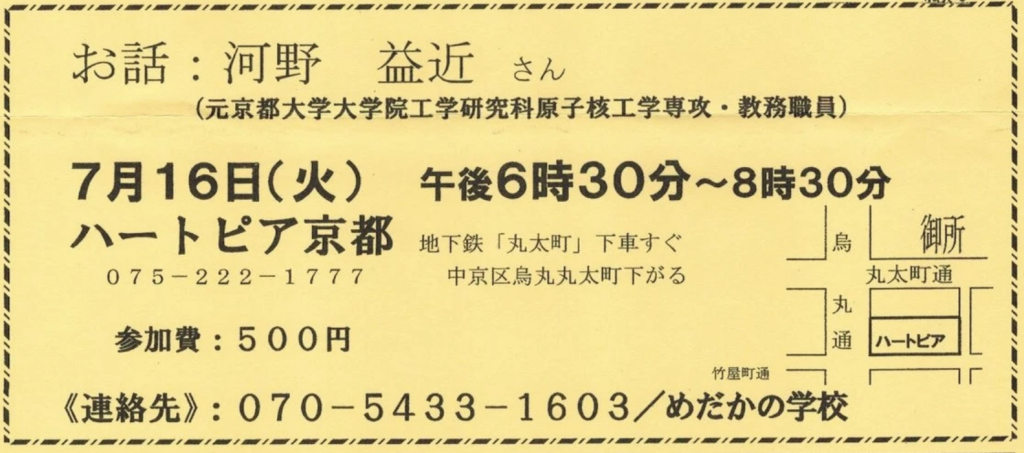
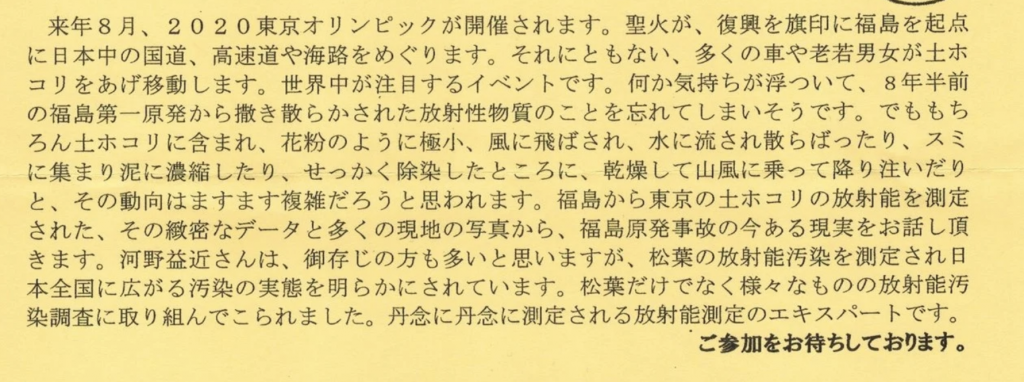
福島原発事故、今ある事実を「土ほこり」に知るvia 京都反原発めだかの学校・学習会

〜福島から関東、聖火も通る国道沿いの放射能を測り続けて〜

もっと読む。

Posted in *日本語 | Tagged , , | 3 Comments

東京)原発避難、原発労働…市民団体ら研究発表 杉並 via 朝日新聞

反原発運動の理論的指導者といわれた故高木仁三郎さんの遺志で設立された「高木基金」(代表理事・河合弘之弁護士)の昨年度助成を受けた団体や個人20件の研究成果発表会が13、14の両日、東京都杉並区明治大学で行われた。

 基金は科学的な考察に裏づけられた批判ができる「市民科学者」の育成・支援を目的に助成している。[…] 、住民説明会も「避難計画への不満を共感しあうだけの場になっている」と報告した。

また、「被ばく労働を考えるネットワーク」は稲葉奈々子教授らとフランスなど海外の原発労働者の状況を調査。「複数の国の原発で働く労働者の合計被曝(ひばく)線量が管理されていない」などと問題点を指摘した。

 「新外交イニシアティブ」は日米原子力協定に関し、米国側の動向の調査を行った。代表の猿田佐世弁護士は「米国では原発は斜陽産業で経済的にペイしないと思われている」とし、「米国では原発推進派でも安全保障上の観点から日本の再処理反対の人が多い」と報告した。

別ウインドウで開きます

 報告は近く高木基金のホームページ(http://www.takagifund.org/)で公開する予定。(青木美希)

全文

Posted in *日本語 | Tagged | 3 Comments

The Hoax Nuclear Power Is Green via Enviro Video 1

Posted in *English | Tagged , , , , , , , | 3 Comments