Daughters of the bomb: my reckoning with Hiroshima, 75 years later via The Guardian

Erika Hayasaki for Narratively

On the 75th anniversary of the A-bomb, a Japanese American writer speaks to one of the last living survivors – and traces connections from Malcolm X to the fight to end nuclear war

I keep a red file folder, its edges faded from nearly three decades of exposure to dust and light. Inside, the title words I typed in 1991: “The Atomic Bombing of Hiroshima.” It is the first research paper I ever wrote. Tucked inside of the folder’s front flap are three stapled index cards, each with reference titles written in smudged pencil. The first book listed is the one that mattered to me most: the journalist John Hersey’s 1946 nonfiction classic Hiroshima. The book’s scenes, vivid and wrenching, are lodged inside my memory. Particularly this one, about the Rev Kiyoshi Tanimoto, pulling bomb victims from a sand pit: “He reached down and took a woman by the hands, but her skin slipped off in huge, glove-like pieces.”

Hersey introduced me to Mr Tanimoto, a man who wore his hair parted down the middle and moved through crowds of mangled, dying people, bringing water and apologizing: “Excuse me for having no burden like yours.” At a time when Japanese people were roundly excoriated in the US, portrayed as demons, yellow monkeys, and savages deserving of death, one historian claimed Hersey’s book transformed “subhuman Japs back into Japanese human beings”. His omniscient, controlled voice felt godlike and all-knowing, free from authorial editorializing. He was hailed as a writer who “let ‘Hiroshima’ speak for itself”.

When I first read the book in 1991, I was struggling to make sense of my place among some Americans who still – 46 years after the bomb – saw someone like me as subhuman. I was a child with a Japanese immigrant father (he was born three years after the bomb) and a white mother. I grew up in a small midwestern town as one of only a handful of Asians. There was name-calling: “Chink.” “Gook.” “Jap.” There were days when white kids threw rocks at me on the playground or recited the all-too-common phrase: “Go back to where you came from.” Being anti-Asian was an easy fallback for your garden-variety middle school bullies. I have memories of hiding in a blue paint-chipped bathroom stall, wondering what was wrong with me.

[…]

Reading Hiroshima, I learned how Mr Tanimoto ran to look for his wife and baby, encountering hundreds of fleeing people along the way. “Many were naked or in shreds of clothing,” Hersey wrote. “On some undressed bodies, the burns had made patterns – of undershirt straps and suspenders.” The shapes of flowers from kimonos seared on to their skin.

My personal torment suddenly fit into a context of racism and war. Classes at school did not teach me about the internment of Japanese Americans, nor about all of the rest of the groups deemed subhuman. So, as a teenager, I went searching for more books that did.

[…]

It was through my grandfather’s stories that I also learned more about my grandmother’s brother, Jim, a graduate student of the University of Wisconsin who studied nuclear physics. Jim had been recruited right out of college to work on a top-secret project in Los Alamos, New Mexico. Years later, the family would come to find out what Jim had been working on all of that time: the Manhattan Project. My American great-uncle, as it turned out, helped build the very same atom bombs that destroyed Hiroshima, and three days later, Nagasaki.

[…]

Kondo had lived in the US during the height of the civil rights movement, first at a junior college in New Jersey, and then as a student at American University in Washington, DC. She learned about freedom protests for Black Americans, and she came to admire the Rev Martin Luther King Jr, who wrote: “The tendency of most is to adopt a view that is so ambiguous that it will include everything and so popular that it will include everybody.”

Kondo realized her own calling when it came to social justice was to take on the legacy of Hiroshima. She decided she did not just want to see nuclear weapons controlled or curtailed. She wanted them abolished. And she knew that for as long as she still had her voice, she would continue to tell their story – Hiroshima’s story – to anyone who would listen. Today, Kondo has one unequivocal pursuit: a nuclear-weapon–free world. “For the sake of the children,” she told me.

[…]

Martin Luther King called for the abolition of nuclear weapons, linking the idea to racial harmony: “We must transform the dynamics of the world power struggle from the negative nuclear arms race, which no one can win, to a positive contest to harness man’s creative genius for the purpose of making peace.”

[…]

In 1964, the JapaneseAmerican activist Yuri Kochiyama invited a group of hibakusha to her Harlem apartment. She also invited Malcolm X, who surprised everyone when he showed up and knocked on the door. “You have been scarred by the atom bomb,” he told the Japanese survivors. “You just saw that we have also been scarred. The bomb that hit us was racism.”

 Yuri Kochiyama with two civil rights activists. Kochiyama fought for Latino, African American, Native American and Asian American civil rights and causes. She held weekly open houses for activists in her Harlem apartment. Photograph: Courtesy US National Park Service/Narratively
Eight months later, Malcolm X was gunned down in a ballroom in New York. Kochiyama had developed a friendship with him and was in the ballroom when he was shot. As others fled, she rushed toward him, picking up his head and putting it in her lap, begging him to stay alive.

[…]

Today, the nuclear weapons system is still sanctioned by structures of white supremacy and power, under claims of safety and self-defense. It continues to protect those in power, while nuclear testing harms people of color around the world, contaminating food and water resources and exposing residents to radiation. In the 1960s, France conducted nuclear tests in the Sahara Desert in Algeria, and in French Polynesia until 1996. There has been little to no compensation for victims of those tests. The US also conducted nuclear tests in the South Pacific, to the detriment of impoverished indigenous populations.

In Washington state, the Spokane tribe of Indians has long suffered from health and environmental damage due to a uranium mine for nuclear weapons, which closed in 1981, though cleanup did not begin until 2017. Native American tribes in close proximity to the Hanford site in Washington State, a decommissioned nuclear production complex, were also exposed to radioactive contamination. And a birth study of the Navajo Nation, which spans Utah, New Mexico and Arizona, found that 27% of those tested had high levels of uranium in their urine, decades after the nuclear weapons mines were closed.

Read more at Daughters of the bomb: my reckoning with Hiroshima, 75 years later
Posted in *English | Tagged , , | Comments Off on Daughters of the bomb: my reckoning with Hiroshima, 75 years later via The Guardian
Hiroshima at 75: A Painful Legacy Tempered by Hope and a Treaty via The Diplomat

[…]

That morning, August 6, 1945, the United States detonated an atomic bomb for only the second time. Three weeks earlier the Trinity test, conducted in New Mexico, marked the first successful detonation of a nuclear device. The second detonation was no test.

A 15 kiloton uranium bomb, codenamed “Little Boy,” was dropped over Hiroshima. Prior to the attack, residents of the city had grown increasingly unsettled, wondering why Hiroshima, one of the largest cities in Japan, had been ominously spared by merciless bombings that razed scores of other Japanese cities.

Setsuko and her parents were not among the tens of thousands of civilians killed by the bomb dropped that day, but Setsuko’s older sister Ayako and 4-year-old son Eiji, who had returned to Hiroshima for a doctor’s appointment, were. 

[…]

Seventy-five years later, speaking from her home in Toronto, Setsuko’s voice shivers with anguish as she describes how two Japanese soldiers doused her sister and nephew’s bodies in gasoline and used bamboo poles to turn them in an open cremation while their family stood frozen, watching numb with shock.

[…]

Setsuko, who campaigned tirelessly in partnership with ICAN, celebrated knowing that after the nuclear weapons ban treaty has been ratified by 50 nations, it will enter into force and the development, testing, production, acquisition, possession, stockpiling, or threatened use of nuclear weapons will become illegal under international law. 

Currently, 40 nations have ratified the ban treaty, which is vigorously opposed by the nine nuclear armed states, as well as 30 nuclear endorsing states including Japan and Canada, where Setsuko is a citizen and has resided since marrying Canadian historian Jim Thurlow in 1955.

This year, Setsuko wrote 197 letters to leaders and heads of state of all nations of the world, including a letter to Canadian Prime Minister Justin Trudeau imploring him to acknowledge Canada’s frequently overlooked role in supporting the Manhattan Project while also calling on Canada to ratify the ban treaty.

Setsuko has written to Japanese Prime Minister Shinzo Abe repeatedly but says, “Every time I go to Tokyo, he’s always too busy. Of course he is avoiding me.” The 88-year-old peace activist wonders aloud why the prime minister is afraid to meet her. “I don’t have anything scary but the truth.”

When Setsuko hears diplomats and policy experts discuss nuclear strategy and deterrence theory, she wishes they would instead think of Eiji, her 4-year-old nephew killed by the bomb who, she says, represents all the innocent children that could be killed if any of the world’s more than 13,000 nuclear weapons were used.

The abolition of nuclear weapons, Setsuko argues, “is much too important just to leave it to the politicians. We are talking about life and death issues.”

Under Abe, Japan has had a muted response to U.S. withdrawals from international arms treaties as well as a recent report that the Trump administration was considering the possible resumption of explosive nuclear weapons testing.

Japan’s “chummy” relationship with the United States, Setsuko says, is indicative of an alliance she calls “total subservience to U.S. policy.” She insists Abe and Japan’s powerful Liberal Democratic Party’s opposition to the ban treaty is out of step with public opinion.

[…]

Read more.

Posted in *English | Tagged , , | Comments Off on Hiroshima at 75: A Painful Legacy Tempered by Hope and a Treaty via The Diplomat

[インタビュー]「原発汚染水、ひとまず地上のタンク保管が最も現実的で安全」via Hankyoreh

松久保肇・日本原子力資料情報室事務局長
 
原発周辺の広大な土地を活用すべき 
タンクに入れた後、コンクリートで固める案も
 
日本国民も同意しない海洋放出を止めるべき 
韓日市民の連帯など国際的圧力がカギ

「福島原発の汚染水はひとまず地上のタンクでの保管を継続すべき。タンク容量が足りなくなったからといって海洋放出という選択肢はあり得ない」

日本原子力資料情報室(CNIC)の松久保肇事務局長は最近、「ハンギョレ」との書面インタビューで、福島原発の汚染水処理と関連し、最も現実的かつ安全な対策とは何かという質問に対し、このように答えた。原子力資料情報室は、日本の脱原発運動の象徴だった核物理学者、高木仁三郎氏の主導で1975年に設立された市民団体だ。脱原発関連の研究と講演、資料集の発刊など活発に活動している。以下は一問一答。

(略)

-海洋放出を推し進めている理由は何だと思うか。
「日本だけでなくどの国でも原発の運転などで汚染水に含まれるトリチウムは海洋や大気に放出されてきた。その延長線での決定だと思う。また海洋放出が最も安価だということも一因だろう」

-日本国内でも反対の声が高いようだが。
「多くの市民が反対している。特に漁民は“風評被害”など深刻な影響を受けるとして強く反対している。また、福島県内や周辺の複数の議会が汚染水の放出に対する懸念を示す決議を行っている」

-このような反対世論が、政府の政策を変える可能性はあるか。
「特に直接の利害関係者となる漁民の反対の声は強く影響する。以前、東京電力は福島など地元の理解が得られない限り、汚染水を海洋放出しないと文章で約束した」

-汚染水の海洋放出に対し、韓国や海外の環境団体などが制止する方法はないか。

「国連海洋法条約に基づく訴訟などが考えられる。ただ、韓国で稼動中の原発、特に月城(ウォルソン)原発からは大量のトリチウムが放出されている。福島第一原発の汚染水の海洋放出による影響を立証するのはなかなか難しいだろう」

-汚染水処理で最も現実的で安全な対策は何か。
「最も現実的な選択肢は、ひとまずタンク保管を継続することだ。福島第一原発には土地がないというが、周辺には放射性廃棄物を保管するための広大な土地(中間貯蔵施設)がある。経済産業省は他の目的には流用できないといっているが、地権者などと交渉することは可能なはずだ。タンクの容量が足りなくなって放射性物質を海に放出するという選択肢はあり得ない。日本の市民グループは、地上での保管を継続しながら、コンクリートで固めることを提案している。また、海洋放出すれば国際問題になるだろうと政府に警告している」

(略)

再処理工場の問題はそれだけではない。プルトニウムは核兵器の原材料にもなり得る。韓国・日本の市民の連帯で、両国の再処理計画を食い止めなければならない」
キム・ソヨン記者 (お問い合わせ japan@hani.co.kr)
http://www.hani.co.kr/arti/international/international_general/956181.html韓国語原文入力:2020-08-03 04:59
訳H.J

全文は[インタビュー]「原発汚染水、ひとまず地上のタンク保管が最も現実的で安全」

Posted in *日本語 | Tagged , , | Comments Off on [インタビュー]「原発汚染水、ひとまず地上のタンク保管が最も現実的で安全」via Hankyoreh

NC nuclear plant in path of Hurricane Isaias loses power to unit, activates safety system via Fox Business

Tropical Storm Isaias made landfall as a hurricane on North Carolina’s coast

By Evie Fordham

A North Carolina nuclear power plant in the path of Tropical Storm Isaias reported an “unusual event due to a loss of offsite power” that led its safety systems to be activated early Tuesday morning.

The Brunswick plant, on North Carolina’s coast, was in the process of shutting down Unit 1 when the loss of offsite power triggered the safety systems, according to an update posted on the U.S. Nuclear Regulatory Commission website.

[…]

The issue only applied to Brunswick’s Unit 1. Unit 2 was not affected, according to the update from Duke Energy personnel.

Electric power is “essential for safe operations and accident recovery,” and loss of offsite power is “an important contributor to total risk at nuclear power plants,” according to the Nuclear Regulatory Commission.

Read more at NC nuclear plant in path of Hurricane Isaias loses power to unit, activates safety system

Posted in *English | Tagged , | 4 Comments

“Fukushima Ain’t Got Time for Olympic Games” via Fairwinds

Foreword
By Maggie Gundersen

[…]

Prologue & Personal Essay
By Norma Field

A TV set was introduced into our household in 1957. That’s how I date my first encounter with the atomic bomb—not the mushroom cloud, but a grainy black-and-white image of a seated figure, silhouetted because vaporized was a term I didn’t yet know. The figure was so alarming that for days after, I couldn’t understand why grown-ups didn’t spend all their time trying to keep these weapons from ever being used again. It would be years before I put that image together with the earlier memory of breakfast table arguments between my American father, who came to Japan as a member of the US Occupation forces at the end of WWII, and my Japanese mother. My father insisted that the Pacific testing of nuclear weapons was necessary to defeat the Commies; my mother was adamantly opposed, though I got that only through her frowns and sighs. The power relationship between victor and vanquished was unambiguous even for a preschooler.

Trying to learn about the Fukushima nuclear disaster that began on March 11, 2011, I realized it would test whatever knowledge and tools for grappling with the world I had collected in adulthood. I had never bought the Japanese government campaign to get the Japanese people over their “nuclear allergies” and accept nuclear power. Still, the link between weapons and energy was fleshed out through the too-short life of my friend Sharon Stephens, an anthropologist who studied the impact of Chernobyl on the indigenous children of Scandinavia. Through her work, she came to understand that her health problems, dating back to childhood, were likely related to her having grown up as a downwinder of the Hanford Nuclear Reservation, where the plutonium for the Nagasaki bomb was produced. She became interested in exploring the secrecy that haunts individuals, families, and communities around nuclear harm.

In Fukushima, the divisions induced among those put in harm’s way emerged early on as a most painful, intractable issue. First and foremost, the divisions are an expression of the terror provoked by the prospect of radiation exposure, especially given the knowledge that illness does not announce itself immediately. Such is the lingering power of “Hiroshima” and “Nagasaki.” Those who could flee are envied and resented by those who could not. Evacuation is a direct statement of danger perceived. Parents who feel powerless to protect their children, who are desperately trying to stay upbeat, don’t appreciate parents who voice anxiety. Others warn that to worry out loud is to impede economic recovery. And still others say to point out Fukushima risk is to engage in Fukushima discrimination, an ominous reference to the marriage and employment discrimination faced by the sufferers of the Hiroshima and Nagasaki bombs. As if impaired health, or the possibility of such, actually warranted such discrimination. Better to leave such issues unexplored; better yet, to deny the presence of risk factors altogether.

[…]

This Will Still Be True Tomorrow: “Fukushima Ain’t Got the Time for Olympic Games”: Two Texts on Nuclear Disaster and Pandemic
Article was originally published in The Asia-Pacific Journal: Japan Focus.
By Muto Ruiko
Introduced and translated by Norma Field
Abstract (1)
The fear of being forgotten that haunts the victims of the Fukushima nuclear disaster set in quickly in the months following March 11, 2011. The Tokyo Olympics, touted as the “Recovery Olympics,” has served as a powerful vehicle for accelerating amnesia, on the one hand justifying the rushed reopening of restricted zones and other decisions of convenience, on the other, programming moments highlighting Fukushima in the Games. As preparations for the latter, especially the torch relay, reached fever pitch, the novel coronavirus intervened to force an abrupt postponement. It also disrupted ongoing and special events planned for the ninth 3.11 anniversary. The essay below elaborates on that context as an introduction to two texts by Muto Ruiko, head of the citizens’ group whose efforts led to the only criminal trial to emerge from the Fukushima disaster. The first, a speech anticipating the torch relay, outlines what the Olympics asks us to forget about Fukushima; the second is a reflection on living under two emergency declarations, the first nuclear, the second, COVID-19.
Key words: Olympics; Fukushima; torch relay; COVID-19; coronavirus; Dentsu; activism; Muto Ruiko

Read more at “Fukushima Ain’t Got Time for Olympic Games”

Posted in *English | Tagged , , | Comments Off on “Fukushima Ain’t Got Time for Olympic Games” via Fairwinds

Commentary: The mayor of Nagasaki’s peace message to Illinois and the world via Chicago Tribune

Seventy-five years ago, on Aug. 9, 1945, the second atomic bomb following Hiroshima was detonated over our city, Nagasaki, Japan. The city was left in smoldering ruin by the blast wave and ferocious heat, and more than 150,000 people were killed or injured.

In order to prevent a repetition of the tragedy wrought by nuclear weapons, Nagasaki residents have continued to convey the reality of the atomic bombing and have appealed for the abolition of nuclear weapons. We are not making an appeal as past victims, but as global citizens who live in a world where the danger of nuclear weapons is very real; we are sounding the alarm to the continued threat that they pose. The passing of the Treaty on the Prohibition of Nuclear Weapons by the United Nations in 2017 fulfilled the long-awaited wishes of the hibakusha, the atomic bomb survivors, and civil society who have been longing for a peaceful world.

[…]

Last November, Pope Francis visited Nagasaki and delivered an explicit and powerful message to the world. His Holiness stated that a peaceful world without nuclear weapons is possible, realizing this ideal calls for “involvement on the part of all.” The initiatives taken by local authorities and civil society to support the treaty play an important role in building consensus that the “TPNW is the international norm.”

Last January, Evanston adopted the first resolution in Illinois which supports the TPNW and asks Congress to ratify it. I hope other Illinois cities, including Chicago, will adopt similar resolutions. The “Hibakusha International Appeal” is one activity undertaken at the grassroots level calling for the early entry into force of the TPNW. If such movements gain traction, it would create momentum that can sway the government.

[…]

Although my planned visit to Chicago this May was canceled due to the COVID-19 pandemic, I look forward to making this visit in the near future and jointly creating a “culture of peace” under the slogan “Let Nagasaki be the last atomic-bombed site in the world.”
Tomihisa Taue is the mayor of Nagasaki, Japan.

Read more at Commentary: The mayor of Nagasaki’s peace message to Illinois and the world

Posted in *English | Tagged , , | 4 Comments

#75 years of resilence via #stillhere

The hibakusha, or those who survived the nuclear attacks in Hiroshima and Nagasaki, are the best known nuclear survivors, but they are not the only ones.

Downwinders grew up near America’s nuclear testing and production sites in places like Utah, New Mexico and Washington State. They are survivors. People from the Marshall Islands endured 12 years of U.S. nuclear testing, and continue to face the negative health consequences of those tests. They are survivors. U.S. military veterans sent to observe nuclear tests and clean up nuclear waste have fought for years for compensation for the harm they’ve suffered. They are survivors. Uranium workers mined and produced the raw materials to make nuclear weapons, often on Indigenous land, without ever being told of the severe health risks. They are survivors.

And every survivor has a story.

Read more.

Posted in *English | Tagged , , , , , | 4 Comments

U.A.E. Becomes First Arab Nation to Open a Nuclear Power Plant via The New York Times

The launch is raising concerns about the growing number of nuclear programs in the volatile Middle East.

By Vivian Yee

BEIRUT, Lebanon — The United Arab Emirates became the first Arab country to open a nuclear power plant on Saturday, raising concerns about the long-term consequences of introducing more nuclear programs to the Middle East.

Two other countries in the region — Israel and Iran — already have nuclear capabilities. Israel has an unacknowledged nuclear weapons arsenal and Iran has a controversial uranium enrichment program that it insists is solely for peaceful purposes.

The U.A.E., a tiny nation that has become a regional heavyweight and international business center, said it built the plant to decrease its reliance on the oil that has powered and enriched the country and its Gulf neighbors for decades. It said that once its four units were all running, the South Korean-designed plant would provide a quarter of the country’s electricity.

Seeking to quiet fears that it was trying to build muscle to use against its regional rivals, it has insisted that it intends to use its nuclear program only for energy purposes.

But with Iran in a standoff with Western powers over its nuclear program, Israel in the neighborhood and tensions high among Gulf countries, some analysts view the new plant — and any that may follow — as a security and environmental headache. Other Arab countries, including Saudi Arabia, are also starting or planning nuclear energy programs.

The Middle East is already riven with enmities that pit Saudi Arabia and the U.A.E. against Iran, Qatar and Iran’s regional proxies. One of those proxies, the Yemen-based Houthi rebel group, claimed an attack on the Barakah plant when it was under construction in 2017.

[…]

Read more.

Posted in *English | Tagged , | 6 Comments

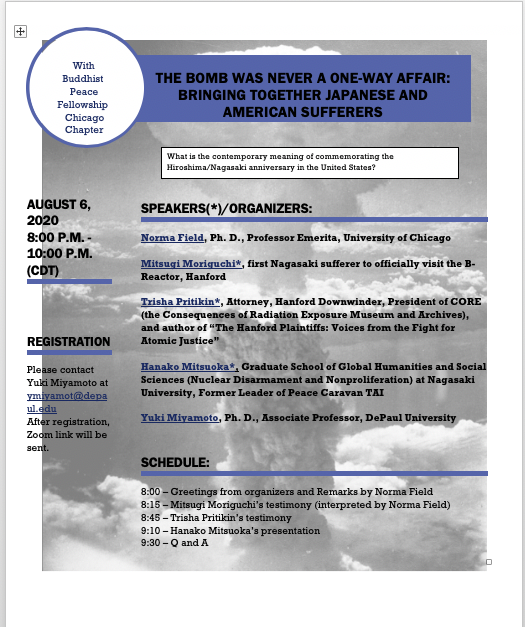
The Bomb Was Never a One-Way Affair: Bringing Together Japanese and American Sufferers (webinar)

Thursday, August 6, 8:00 p.m. -10:00 p.m.

To register, please contact Yuki Miyamoto at ymiyamot@depaul.edu

Posted in *English | Tagged , , | Comments Off on The Bomb Was Never a One-Way Affair: Bringing Together Japanese and American Sufferers (webinar)

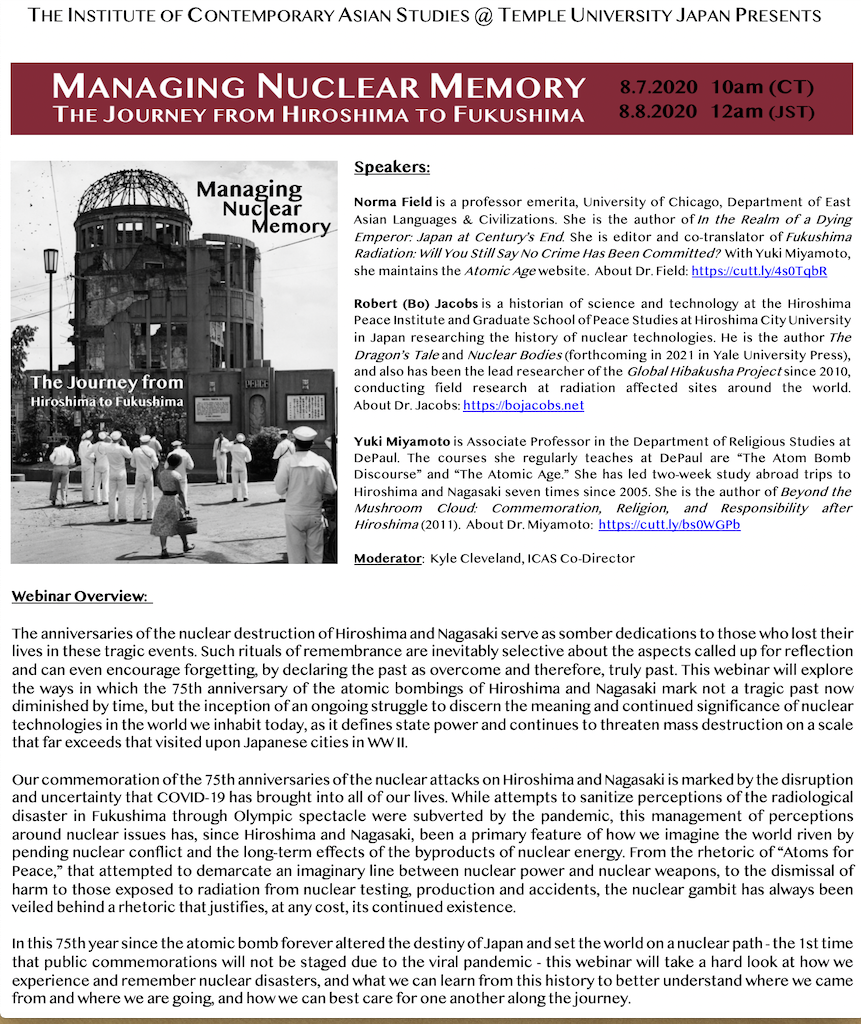
75th Anniversary Commemoration of Hiroshima & Nagasaki via Institute of Contemporary Asian Studies (Temple University Japan Campus)

ICAS Webinar (Online)

“Managing Nuclear Memory: The Journey from Hiroshima to Fukushima”

  • Date/Time:  August 7  10:00am  Chicago (CT)  |  August 8  12:00am  Tokyo (JST)
  • Webinar access link:   https://temple.zoom.us/j/8166385428M | Meeting ID: 816 638 5428
  • Moderator:  Kyle Cleveland, ICAS Co-Director
  • Watch video here.

For more information, see here.

Posted in *English | Tagged , , , , | 10 Comments