This Vanishing Moment and Our Vanishing Future via TomDispatch

By Nick Turse

It was the end of the world, but if you didn’t live in Hiroshima or Nagasaki, you didn’t know it. Not in 1945 anyway. One man, John Hersey, brought that reality to Americans in an unforgettable fashion in a classic 1946 report in the New Yorker magazine on what happened under that first wartime mushroom cloud. When I read it in book form as a young man — and I did so for a personal reason — it stunned me. Hersey was the master of my college at Yale when I was an undergraduate and he was remarkably kind to me. That report of his from Hiroshima would haunt me for the rest of my life.

[…]

Then its Japanese editor invited me to visit his country, ostensibly to meet other publishers there. Born near Nagasaki, however, it turned out he simply couldn’t believe an American editor had been willing to publish that book of his and had a deep desire to take me to Hiroshima. I was impressed by the bustle of Tokyo and the beauty of Kyoto, but Hiroshima? To be polite, I agreed to go, but I felt blasé about it. After all, I had already published the book. I knew what had happened. By then, Hiroshima was, of course, a thriving city, but he took me to the Hiroshima Peace Memorial Museum. Even with its caramelized child’s lunch box and other artifacts, it could catch but the slightest edge of that nightmare experience. Still, emotionally it blew me away. Despite Hersey, despite Unforgettable Fire, despite Hiroshima Mon Amour, I realized that I had grasped next to nothing about the true nature of atomic warfare. When I returned to the U.S., though I couldn’t stop talking about Japan, I found that I could hardly say a word about Hiroshima. What being unable to truly duck and cover meant had overwhelmed me.

So, as the world enters yet another (hypersonic) nuclear arms race and the Trump administration tears up Cold War nuclear pacts, I understand just why TomDispatch managing editor Nick Turse reacted so strongly (as I did when I read it this summer) to a powerful, new book on John Hersey’s Hiroshima experience, Lesley Blume’s Fallout: The Hiroshima Cover-up and the Reporter Who Revealed It to the World. He and I have both been living with Hersey’s Hiroshima report for a lifetime in a world that somehow refuses to grasp, even on an increasingly apocalyptic planet, what nuclear war truly means.

-Tom Engelhardt, TomDispatch

Whether you’re reading this with your morning coffee, just after lunch, or on the late shift in the wee small hours of the morning, it’s 100 seconds to midnight. That’s just over a minute and a half. And that should be completely unnerving. It’s the closest to that witching hour we’ve ever been.

[…]

Only the Essentials

When I pack up my bags for a war zone, I carry what I consider to be the essentials for someone reporting on an armed conflict. A water bottle with a built-in filter. Trauma packs with a blood-clotting agent. A first-aid kit. A multitool. A satellite phone. Sometimes I forgo one or more of these items, but there’s always been a single, solitary staple, a necessity whose appearance has changed over the years, but whose presence in my rucksack has not.

Once, this item was intact, almost pristine. But after the better part of a decade covering conflicts in South Sudan, the Democratic Republic of CongoLibya, and Burkina Faso, it’s a complete wreck. Still, I carry it. In part, it’s become (and I’m only slightly embarrassed to say it) something of a talisman for me. But mostly, it’s because what’s between the figurative covers of that now-coverless, thoroughly mutilated copy of John Hersey’s Hiroshima — the New Yorker article in paperback form — is as terrifyingly brilliant as the day I bought it at the Strand bookstore in New York City for 48 cents.

[…]

The tale of how John Hersey got his story is a great triumph of Lesley Blume’s Fallout, but what came after may be an even more compelling facet of the book. Hersey gave the United States an image problem — and far worse. “The transition from global savior to genocidal superpower was an unwelcome reversal,” she observes. Worse yet for the U.S. government, the article left many Americans reevaluating their country and themselves. It’s beyond rare for a journalist to prompt true soul-searching or provide a moral mirror for a nation. In an interview in his later years, Hersey, who generally avoided publicity, suggested that the testimony of survivors of the atomic blasts — like those he spotlighted — had helped to prevent nuclear war.

“We know what an atomic apocalypse would look like because John Hersey showed us,” writes Blume. Unfortunately, while there have been many noteworthy, powerful works on climate change, we’re still waiting for the one that packs the punch of “Hiroshima.” And so, humanity awaits that once-in-a-century article, as nuclear weapons, climate change, and cyber-based disinformation keep us just 100 clicks short of doomsday.

Hersey provided a template. Blume has lifted the veil on how he did it. Now someone needs to step up and write the world-changing piece of reportage that will shock our consciences and provide a little more breathing room between this vanishing moment and our ever-looming midnight.

Read more
Posted in *English | Tagged , , , , | 6 Comments

被曝データ不正利用で研究者批判〜伊達市議会で中間報告 via OurPlanet-TV

東京電力福島第一原子力発電所事故後、伊達市住民の個人線量データを住民の同意を得ず、被曝の過小評価につながる論文を執筆し、論文撤回に至っている問題で24日、議会調の特別委員会が中間報告を行った。研究者らが伊達市に責任転嫁していることについて、「罪を糊塗する行為」 だと厳しく糾弾。また田中俊一氏との関係も指摘するなど、踏み込んだ報告書となっている。

問題となっているのは、福島県立医科大学の宮崎真講師と東京大学の早野龍五名誉教授が、2016年と2017年にかけて、英国の科学雑誌に発表した2つの論文。伊達市の調査委員会が今年2月、個人情報保護条例違反の疑いを指摘した報告書を公表したが、市議会がこれを受けて特別委員会を設置して、市の調査結果を検証していた。

データ違法入手を隠蔽」と指摘
特別委員会の菊地邦夫委員長はまず、研究者らがインフォームドコンセントを全く実施していなかったことを問題視。「説明どころか同意、不同意など無視して執筆しようとしていた可能性が高い」と強い言葉で非難した上で、「責任を市のデータ提供に問題があるがごとく責任転嫁し免れようとすることは、研究者として罪を糊塗する行為である」 と研究者の責任を指摘した。

さらに市長名で発出された2015年8月1日づけの「論文依頼書」が、実際には10月下旬に作成されていたことについて、「市民データを違法に入手したことを隠蔽するための工作」だったと指摘。すでに解析ずみであったにもかかわらず、宮崎氏が形式的に倫理審査会に申請をし、博士号まで取得していたと述べ、しかも、宮崎氏の論文撤回コメントまでもが不正であると厳しく批判した。

市の調査漏れを指摘〜2014年のフライング提供
このほか、報告書では、市の調査委員会の調査漏れも指摘した。市の調査報告書では、2015年2月と同年8月のデータ提供のみが報告されているが、2014年12月に、宮崎氏が同市の半澤隆弘直轄理事(当時)に対し、手続きを無視して、裁量で早野氏へデータを提供するよう依頼していたメールの存在を紹介。「個人情報保護法を無視し、違法提供、幇助、違法入手した」と指摘した。

伊達市の「伊達市被ばくデータ提供に関する調査委員会」報告書
https://www.city.fukushima-date.lg.jp/soshiki/3/39948.html

田中俊一氏への解析データ提供にも言及
さらに報告書では、事故後、伊達市の市政アドバイザーに就任し、その後、原子力規制委員長に就任した田中俊一氏へ解析データがわたっていたことにも言及。避難指示の指定や解除を担う内閣府の原子力被災者生活支援チームの会議資料の中に、同部署の担当者が2013年6月、宮崎氏やな早野氏らと線量計測について打ち合わせしていた事実が記載されいると指摘。2015年10月20日に、早野氏から田中氏に対して、解析データが提供されていたとした上で、伊達市のデータが違法な手段で提供され、国の政策を左右していることを示唆した。

報告書は、田中氏は昨年4月4日の読売新聞紙上で、「論文が取り下げられるとしても、適切な手続きを経てデータの解析はやり直されるべきだ。その成果は、他の市町村の被曝線量の推計や低減策に役立つだろう」と述べていることにも触れ、食品や空間線量の基準を緩和する立場に立っている田中氏が、同論文に影響を与えた可能性も指摘した。

宮崎氏や早野氏に対するデータ提供をめぐっては、今なお、未解明な点が残っており、市の職員が持ち出したCD-Rも今なお3枚が行方不明のままだ。その中には住所や年齢、個人番号など70項目の個人情報が含まれいているなどとして、報告書では、市だけでなく、市議会にも適切な対応をするよう求めた。調査特別委は、来年3月頃までに最終報告をまとめたいとしている。

原文

Posted in *日本語 | Tagged , , | 5 Comments

「東電スペシャル」丸のみした東京電力 審査異例づくし via 朝日新聞

 あれだけの大事故を起こした事業者に再び原発を動かす資格があるのか。東京電力の「適格性」は、福島第一原発事故の反省から生まれた原子力規制委員会の最重要課題の一つだった。柏崎刈羽6、7号機(新潟県)の審査で規制委は、安全最優先の姿勢など基準のないものについても「東電スペシャル」(更田豊志委員長)として異例の要求を重ね、了承に踏み切った。

 東電が6、7号機の再稼働を目指して審査を申請したのは2013年9月。事故発生から2年半しか経っていなかった。規制委は他電力と同じように、地震や津波の想定の引き上げや重大事故対策などを技術的に審査。福島第一と同じ沸騰水型(BWR)では最も早く進み、17年夏には新規制基準への適合を認める審査書案がほぼまとまった。

 並行して規制委は、小早川智明社長ら経営陣を呼んで企業姿勢をただした。福島第一の汚染水処分の判断を国任せにするような発言もあり、田中俊一委員長(当時)は「(福島第一の)廃炉を主体的にやりきる覚悟を示せなければ、柏崎刈羽を運転する資格はない」などと厳しく批判した。

 その結果、廃炉への覚悟やリスク低減の継続的努力など7項目を社長名の文書で回答させ、原子炉等規制法に基づく許認可の一つで、違反すれば運転停止もありうる保安規定に反映すると約束させた。こうして適格性の担保に道をつけ、審査書を正式決定した。

 保安規定の審査でも特別態勢をとった。ふつうは規制委員1人がトップとなる審査チームでおこなうが、適格性に限って、5人の委員全員がそろう場で記載内容を逐一確認。原発事故の強制起訴裁判で東電の旧経営陣が展開した無罪主張を引き合いに、事故時に社長の刑事責任を問える体制作りなども追加で求めた。

 保安規定が認可されなければ再稼働できない。東電は要求を丸のみするしかなかった。「リスク対応を怠って事故が起きれば、社長の刑事責任や損害賠償責任が認められる」と明記した弁護士の意見書を提出。リスク情報に対応した記録の保存期間を「5年」と説明して規制委側から「大きな失望を感じる」と批判されると、次の会合ですぐに「廃炉まで」に延ばした。

原文

Posted in *日本語 | Tagged , , , | 4 Comments

A Look Inside the Shuttered, Cold War-Era Nuclear Plant on the Potomac via The Washingtonian

By Jim Swift

SM-1 was once part of plan for the military to generate its own power anywhere. Now it’s a decaying building filled with decaying radiation.

Potomac boaters have seen, at least part of it, for decades as they fished or played on the river near Fort Belvoir: An approximately eight-story-high white smokestack that’s currently home to an osprey. There’s a duck blind nearby for on-base hunting, near a large outfall pipe you can see at low tide and an old pier that conceals an intake pipe.

These images are all that most people will ever see of the SM-1 nuclear reactor that’s sat on Fort Belvoir, unused since 1973, when the Army shut it down and removed its fuel rods and waste. It turned the former “Atoms for Peace” training reactor into a museum a few years later. But the only people who could visit were others in the military or those who could get on base to the highly restricted “300 Area.” The museum closed a decade or so later.

[…]

The plant was called SM-1. That was short for Stationary, Medium-size reactor, the first of its kind, built in 1957. (The Army later built a stationary reactor in Fort Greeley, Alaska, and a portable one, PM-2A, to Greenland. Other reactors part of the Army Nuclear Reactor Program were stationed across the world either through the Army or other military branches. )  While the 2 megawatts of power it generated aren’t much by the standards of today—Dominion’s Possum Point power plant 12 miles down the Potomac generates more than 800 times as much electricity from gas and oil—it was the first nuclear reactor in the United States ever connected to the commercial power grid.

SM-1 represented the military’s hope that nuclear power wouldn’t just be used on ships and submarines but could harness the power of the atom to power American military facilities throughout the world where resupplying would be difficult. It was also where the Army trained nuclear operators from across all the armed forces.

[…]

The Army Corps of Engineers, which is overseeing the remediation project, hopes to return the ground under SM-1 to usable land within the next few years, perhaps by 2025. But first, it has to remove the most radioactive material, which remains in a sealed containment vessel that was briefly (and in unauthorized fashion) painted to resemble an 8-ball. The Army Corps of Engineers will work with an Alexandria-based contractor to dismantle and dispose of what’s left.

[…]

Read more.

Posted in *English | Tagged , | Comments Off on A Look Inside the Shuttered, Cold War-Era Nuclear Plant on the Potomac via The Washingtonian

Don’t criticize government or TEPCO, guides in Fukushima told via The Asahi Shimbun

Tour guides are bristling at instructions not to criticize the central government or Tokyo Electric Power Co. when speaking to visitors at a recently opened memorial museum to the 2011 triple meltdown at the Fukushima No. 1 nuclear power plant.

The instructions have left some Fukushima residents who signed up to be guides feeling perplexed and sparked anger in others.

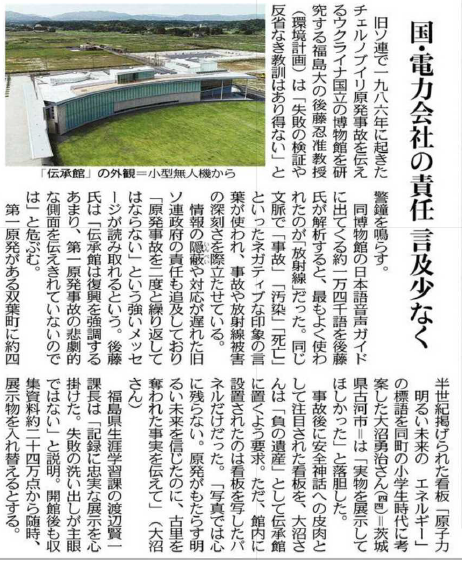
The museum in Futaba, Fukushima Prefecture, opened on Sept. 20 with the objective of passing on to visitors the lessons learned from the nuclear disaster triggered by the Great East Japan Earthquake and tsunami.

[…]

About 150 items chosen from the 240,000 or so materials collected from around the nation are on display at the facility operated by the Fukushima Innovation Coast Framework Promotion Organization. The central government effectively paid for the 5.3 billion yen ($50 million) that went into completing it.

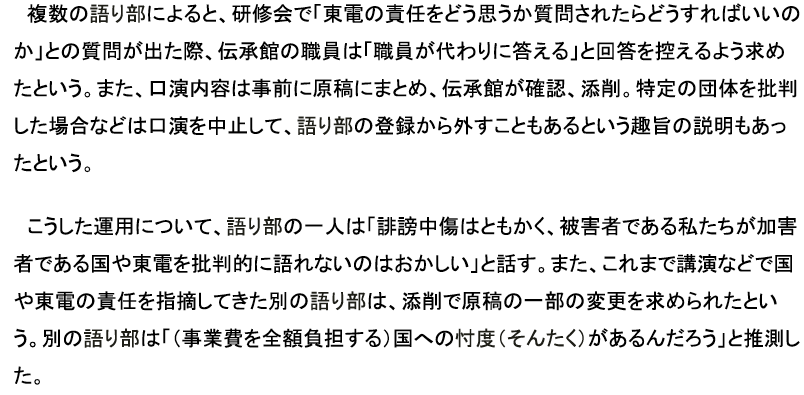
The museum has 29 registered guides who either survived the 2011 disaster or underwent a training program for the work. They rotate on a daily basis and talk to visitors about their experiences, which include how they lived while living as evacuees and losing their homes in the tsunami.

Each session lasts for a maximum one hour and the guide is paid 3,500 yen for each session.

Training sessions were held in July and August for the guides in which a manual was distributed that included wording to avoid “criticizing or defaming specific organizations, individuals or other facilities.”

One question raised was what to say if a visitor asked what the guide felt about TEPCO’s responsibility, according to several guides who took part in the training sessions.

The guides were told to not directly respond to such questions, but to leave the matter up to facility staff who would be sitting in on the sessions.

Each guide was also asked to write down a script of what they intended to say. The draft was checked and revised by facility staff.

The guides were also told that if they did criticize a specific organization, their talks would be stopped immediately and they would be dismissed as a registered guide.

The manual also included instructions to contact and consult with facility staff if the script was to be changed or if the guide was contacted by media representatives for an interview.

With regard to the manual and instructions, one guide said, “While defamation is out of the question, I think it is wrong that as a victim I am unable to criticize the central government or TEPCO, which is responsible for the damage.”

A second guide had the script revised after pointing out the responsibility of the central government and TEPCO.

Another speculated that the Fukushima prefectural government was not trying to ruffle feathers since the central government had paid for the facility.

“I suffered psychological anguish from TEPCO and I’m also angry with the central government,” one tour guide said.

“To me, that is the truth. The facility has asked us to speak the truth so it is not in a position to say ‘Don’t say such things.’ I will quit as a guide if expressing my feelings is considered being critical.”

A prefectural government official admitted that the central government and TEPCO would be covered by the “specific organizations” clause in the manual.

“We believe it is not appropriate to criticize a third party such as the central government, TEPCO or the Fukushima prefectural government in a public facility,” said another prefectural government official now on the facility staff.

Committees set up by the Diet and central government to investigate the cause of the Fukushima nuclear disaster issued reports that called it a “man-made disaster” and said TEPCO never considered the possibility that the Fukushima plant would lose all electric power sources in the event of an earthquake or tsunami because it stuck to a baseless myth that the plant was safe.

(This article was written by Shoko Rikimaru and Shinichi Sekine.)

Read more.

Posted in *English | Tagged , | 5 Comments

Hanford companies agree to pay $58 million over alleged overcharging of taxpayers via Tri-City Herald

By Annette Carey

The companies building the $17 billion vitrification plant at Hanford have agreed to pay nearly $58 million to the federal government to settle allegations that they billed the Department of Energy for fraudulent labor costs.

Bechtel Corp. and its primary subcontractor, Aecom, were sued in 2017 by four current or former Hanford site employees who said they were retaliated against for raising time-charging issues.

The lawsuit was joined by the Department of Justice and unsealed on Tuesday as the settlement agreement was announced.

“It is stunning that for nearly a decade, Bechtel and Aecom chose to line their corporate pockets by diverting important taxpayer funds from this critically essential effort,” said Joseph Harrington, first assistant U.S. attorney for the Eastern District of Washington state.

Bechtel and Aecom have agreed to fully cooperate and assist the Department of Justice in its ongoing investigation of individuals who helped or participated in fraudulent billing of the federal government, according to the Justice Department.

[…]

The Justice Department said Bechtel and Aecom knowingly overcharged the Department of Energy for unreasonable amounts of time when union construction workers had no work to do between 2009 and 2019. The workers included electricians, millwrights, pipefitters and other skilled workers.

Hanford construction workers are not guaranteed a full day’s work, but are required to be paid for a minimum of two hours on days they are scheduled to work.

Management failed to schedule sufficient work to keep them busy, sometimes for several hours at a time, but still billed DOE for their idle time, according to the Justice Department.

[..]

The practice of billing for unreasonable idle time continued even after the Bechtel and Aecom knew they were being investigated, the Justice Department said.

The total overpayment by DOE to the companies was nearly $26 million, with a higher total to be paid under the agreement as punishment.

“Providing for multiple damages and significant penalties means that a company or individual can’t just falsely claim payments, get caught and then pay back the amount they stole,” said Dan Fruchter, assistant U.S. attorney.

[…]

The vitrification plant has been under construction since 2002 and is scheduled to begin operating by the end of 2023 to turn some of the least radioactive waste held in underground tanks at Hanford into a stable glass form for disposal.

The Hanford nuclear reservation in Eastern Washington has 56 million gallons of radioactive and hazardous chemical waste stored in underground tanks after the production of plutonium for the nation’s nuclear weapons program from World War II through the Cold War.

Bechtel and Aecom bill the Department of Energy for their costs, including labor costs, to build the plant.

As part of the settlement agreement, Bechtel and Aecom will pay for a full-time independent monitor and assistant monitor of labor charging for three years. These will be selected by the Department of Justice and will report to the federal government.

WORKERS TO SHARE IN SETTLEMENT

The four whistleblowers who filed the lawsuit will receive $13.8 million of the settlement money, and $25.8 million will be returned as restitution to the Department of Energy to use for ongoing environmental cleanup at the nuclear reservation.

[…]

This is the second time that Bechtel and its subcontractor have paid millions of dollars to resolve allegations of fraud and overcharging on the vitrification plant project.

In November 2016 they reached an agreement with the Department of Justice to pay $125 million to resolve claims that they knowingly violated quality standards at Hanford and used substandard materials in constructing parts of the plant.

The total also included allegations of using federal funds to lobby Congress to, among other things, try to cut DOE’s budget for independent oversight of work on the plant, according to the Department of Justice.

Read more.

Posted in *English | Tagged , , | 5 Comments

Letter calls on Japan, 21 other nations to ratify nuke ban treaty via The Asahi Shimbun

In an open letter, 56 former world leaders and top officials representing 22 U.S. allies urged their states Sept. 21 to sign a U.N. treaty banning nuclear weapons.

They represent 20 NATO countries as well as Japan and South Korea.

Ban Ki-moon, a former South Korean foreign minister who served as U.N. secretary-general from 2007 to 2016, and Javier Solana, a former NATO secretary-general who also served as Spain’s foreign minister, were among those who signed.

Former Japanese prime minister Yukio Hatoyama, along with Makiko Tanaka, a former foreign minister, and her husband Naoki Tanaka, a former defense minister, also affixed their names to the document, urging the Japanese government to ratify the Treaty on the Prohibition of Nuclear Weapons.

The open letter was coordinated by the International Campaign to Abolish Nuclear Weapons (ICAN), an international nongovernmental organization that was awarded the Nobel Peace Prize in 2017.

The treaty that bans development, manufacturing, possession and use of nuclear weapons was adopted at the United Nations in 2017.

It will take effect 90 days after 50 countries ratify it.

So far, 44 countries and regions have ratified the treaty. But Japan is not one of them.

The Japanese government has stated that “it is necessary to maintain the U.S. nuclear deterrent capability under the Japan-U.S. alliance.”

“The risk of a nuclear weapon detonation today–whether by accident, miscalculation or design–appears to be increasing, with the recent deployment of new types of nuclear weapons, the abandonment of longstanding arms control agreements, and the very real danger of cyber-attacks on nuclear infrastructure,” the open letter states.

It points out that the 22 countries “claim protection” from U.S. nuclear weapons and urges the current leaders of these nations “to advance disarmament before it is too late.”

These countries “should reject any role for nuclear weapons in our defense,” the letter adds.

It goes on to say: “With close to 14,000 nuclear weapons located at dozens of sites across the globe and on submarines patrolling the oceans at all times, the capacity for destruction is beyond our imagination. All responsible leaders must act now to ensure that the horrors of 1945 are never repeated.”

Read more.

Posted in *English | Tagged , , | 4 Comments

福島・双葉町 伝承施設が開館 via 東京新聞

[…]

全文

Posted in *日本語 | Tagged , , , | 4 Comments

国や東電の批判NG? 伝承館語り部に要求、原稿添削もvia 朝日新聞

震災や原発事故の教訓を伝える目的で福島県双葉町に20日に開館した「東日本大震災原子力災害伝承館」が、館内で活動する語り部が話す内容について「特定の団体」の批判などをしないよう求めていることが関係者への取材でわかった。県などによると、国や東京電力も対象だといい、語り部から戸惑いの声があがっている。

 伝承館は、東京電力福島第一原発事故による避難指示が一部で解除されたばかりの双葉町福島県が建設した。各地で収集された24万点の資料から150点あまりを展示する。収集費などを含む計53億円の事業費は国が実質全て負担した。国の職員も出向する公益財団法人「福島イノベーション・コースト構想推進機構」が管理、運営する。

 語り部は養成講座の参加者や経験者から選び、現在29人を登録。日替わりで配置され、原発事故で長引く避難生活や津波で自宅を失った経験などについて語る。1回の口演につき最長1時間ほどで、1回あたり3500円が支払われる。

[…]

[…]

全文

Posted in *日本語 | Tagged , , , | Comments Off on 国や東電の批判NG? 伝承館語り部に要求、原稿添削もvia 朝日新聞

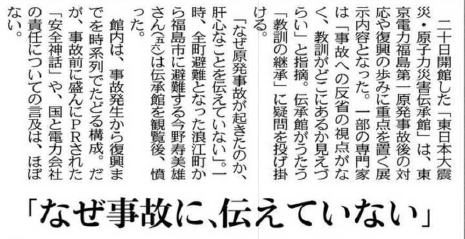
伝承館開館、展示されぬ教訓多く 内容更新求める声も via朝日新聞

 20日、福島県双葉町に開館した県の「東日本大震災原子力災害伝承館」。事故の記録や教訓を伝える目的の施設だが、国や東京電力の津波対策の不備や情報発信のあり方など展示説明が触れない教訓も少なくない。「人災」と指摘される事故の教訓をいかに伝承するか。展示内容の更新や工夫を求める声が上がる。

[…]

 一方、原発事故が「自然災害ではなく明らかに人災」(国会事故調査委員会報告書)と指摘される中、国や東電の事故の責任に関する展示説明は少ない。

[…]

 一方、ウクライナ国立チェルノブイリ博物館や県内の既存施設の展示内容に詳しい福島大学の後藤忍准教授(環境計画)は「失敗を伝えることが次への教訓となるはず」と話す。津波対策の不備については「元の地盤の高さ(35メートル)と敷地の高さ(10メートル)、実際に到達した津波の高さ(15・5メートル)と08年の試算(15・7メートル)を図示すれば、教訓が視覚的にも伝わりやすい」と提案する。

 また、事故直後に住民の不信を招いた国や東電の情報発信のあり方についての説明も欠けている。当時の東電社長が「炉心溶融」という言葉を使わないよう社内に指示した「メルトダウン隠し」や、当時の官房長官が「ただちに健康に影響を及ぼす(放射線量の)数値ではない」と繰り返したことは被災地で不信を招いた「教訓」だが、伝承館での展示説明はない。

 予測結果の公表が遅れたSPEEDI(緊急時迅速放射能影響予測ネットワークシステム)は館内のパネルで「国は予測結果を県災害対策本部に送信したが、情報を共有することができなかった」などと説明するが、批判が集中した公表遅れへの言及はない。

 郡山市から川崎市に自主避難する松本徳子さん(58)は「信頼できる情報がなく、不安で避難した」と当時を振り返り、「なぜ避難せざるをえなかったのか。当時の状況を検証して教訓とし、伝承館で伝えてほしい」と話す。

 また、事故後の避難の様子を伝えるコーナーでは仮設住宅の案内看板や避難所で使ったストーブなどが展示され、被災者が避難生活について語る映像もある。だが、長引く避難生活による体調の悪化などで亡くなる関連死は死者数に触れる程度で、大熊町の双葉病院で入院患者ら約50人が避難で亡くなったことなど、具体的な説明はない。

 「事故前の暮らし」コーナーでは、原発がもたらした雇用など地元への経済効果を説明するが、国から自治体に流れた電源三法交付金の説明がない。交付金でインフラ整備が進む一方、維持費の負担が大きく町の財政悪化を招き、さらに原発依存を深める「副作用」もあった。双葉町の井戸川克隆前町長は「県が建設し、カネを国が出す施設で、自らに都合の悪い説明を避けている」と話す。

 多様な原発事故の実態や教訓を伝えるには、展示資料がそもそも少ないとの指摘があり、桜美林大学の浜田弘明教授(博物館学)は伝承館に展示される167点について、「小規模な企画展の展示数並み」とみる。

 展示に様々な指摘が出ていることについて、その選定に関わった県「資料選定検討委員会」委員で東北大学の藤沢敦教授(考古学)は「原発被害は続いている。開館後も資料収集を続け、批判も受け止めつつ、展示内容の更新や企画展などを行うべきだ」と話す。(力丸祥子、古庄暢、関根慎一)

伝承館で展示や説明がない主な記録や教訓

・国や東電が津波対策を怠った経緯

→過酷事故を想定せず、防潮堤のかさ上げが先送りされた

・「人災」の文言

→国会事故調が事故を「人災」と結論

・国や東電の情報発信

→「メルトダウン隠し」「ただちに健康に影響を及ぼす数値ではない」などが住民の不信を招いた

・損害賠償

→国は賠償費を7兆9千億円と想定。4月から電気料金への上乗せが始まり国民負担も

電源三法交付金

→立地自治体は「電源立地交付金」など多額の交付金を国から受け取っていた

佐藤雄平前知事の県産米安全宣言

→前知事が2011年10月に県産米の「安全宣言」をしたが、11月に基準値超の米がみつかった

全文

Posted in *日本語 | Tagged , , | 4 Comments