arybin on Jun 27th 2012 Innovative Technology,Photography

The prototype machine – dubbed AWARE2 – has the potential to take pictures with resolutions of up to 50 gigapixels, equivalent to 50,000 megapixels, according to the team from Duke University in North Carolina.
It works by synchronising 98 tiny cameras in a single device.
The machine is likely to be used first for military surveillance.
In its current state the researchers say it can take one-gigapixel images at up to three frames per minute.
Via BBC News. For technical information about the project from Duke, click here.
arybin on Mar 7th 2012 Innovative Technology

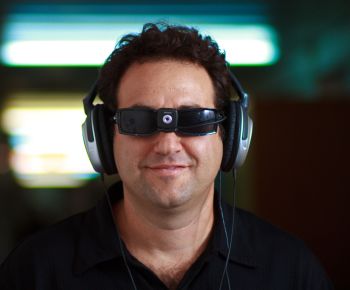
Israeli scientists have developed a “sensory substitution device” (SSD) that they say lets congenitally blind people “see” for the first time ever.
The device… features a tiny computerized video camera that transforms light into so-called “soundscapes”–specific tones that the wearer interprets using his/her sense of hearing.
Read more about the device here. Via Huffington Post.
arybin on Oct 27th 2011 Tech Support

You’ve downloaded a zipped folder of images from LUNA or Webshare – what now?
PC Computers
If you’ve ever had trouble unzipping a compressed folder of images on your computer, please see the following links for instructions on different PC platforms.
Windows XP
Windows 7
Windows Vista
Mac Computers
If you’re using a Mac running OS 10.5 or later, the pre-installed tool called Archive Utility will unzip folders and files by default. After downloading a zipped file or folder, you should see a dialog box that asks if you’d like to open with Archive Utility. Select OK.

The unzipped folder should then be available in your Downloads folder, or wherever you specify downloads to save.
If you are not prompted to open the folder with Archive Utility, try downloading and then double-clicking on the folder or file to unzip.

Please contact the VRC with any questions.
arybin on Jun 27th 2011 Innovative Technology,Photography

Start-up company Lytro is causing a buzz with their so-called light field camera, the first to allow users to shoot first and focus later.
While viewing a picture taken with a Lytro camera on a computer screen, you can, for example, click to bring people in the foreground into sharp relief, or switch the focus to the mountains behind them.
The camera will be released to the consumer market later this year. Via The New York Times.
arybin on Apr 26th 2011 Innovative Technology,Presentation,Tech Support,VRC

Where: CSL — 2nd Floor Cobb — Room C 210
When: Wednesday, April 27, 2011
Time: 1:30 to 2:30
Steven Clancy, Senior Lecturer in Slavic Languages and Literatures and Academic Director of the Center for the Study of Languages, will explore how the iPad can be used in the classroom. If you teach using a laptop computer and you are interested in using an iPad instead, you are encouraged to attend.
Unable to attend? Steven Clancy’s PowerPoint is available for download: Teaching with the iPad.
Via ġeðēode.
arybin on Nov 18th 2010 Innovative Technology,VRC

The article “Digital Keys for Unlocking the Humanities’ Riches” recently published in the New York Times discusses the growing importance of data and technology to research in the humanities.
The next big idea in language, history and the arts? Data.
The focus on digital humanities is timely; this weekend the Visual Resources Center and the Division of the Humanities are co-sponsoring, along with the Newberry Library and Northwestern University, the very first THATCamp Chicago. THATCamp Chicago is a user-generated “unconference” where humanists and technologists work together for the common good. For more information, click here.
See also the University of Chicago Press’ recent blog entry exploring the top five recent books about new methodologies in the digital humanities.
arybin on Dec 18th 2009 Images on the Web,Innovative Technology,Presentation,Software

The New York Public Library’s Picture Collection uses a collaborative web-based discussion and presentation tool, VoiceThread, to show images from their collections to the public and to students in classrooms. VoiceThread allows users to make comments on presentations by webcam, computer microphone, text, or telephone. If leaving a comment by computer, users may also draw on an image to illustrate their opinions.
For more information about VoiceThread, click here.
mmacken on Oct 29th 2007 Innovative Technology,Renaissance - Baroque
From Wired.com:
FLORENCE, Italy — Art diagnostician Maurizio Seracini has waited 30 years to get to the bottom of his biggest mystery yet: whether Leonardo da Vinci’s greatest lost fresco lies behind a wall in the Palazzo Vecchio here.
Seracini’s team of 30 will scan the palazzo’s 177-foot-long wall in mid-November, looking for the Battle of Anghiari, a work so magnificent it has been called the “school of the world.” The $1.5 million search expedition will jump-start a multidisciplinary conservation program at the University of California at San Diego’s Center of Interdisciplinary Science for Art, Architecture and Archaeology.

mmacken on Oct 26th 2007 Innovative Technology
From cnet.com:
Virtual-worlds platform developer Multiverse Network is set to announce a partnership Tuesday [October 9, 2007] that will allow anyone to create a new online interactive 3D environment with just about any model from Google’s online repository of 3D models, its 3D Warehouse, as well as terrain from Google Earth.
The Cochrane-Woods Art Center and the Smart Museum will soon be in Google Earth. The buildings were recreated by Dale Mertes from NSIT. Google Earth is installed on my (Megan’s) computer. Please stop by my desk if you’d like to see our building “in situ”. Learn more…

admin on Sep 28th 2007 Innovative Technology

We believed that slide projectors were no longer in production. The VRC was wrong.
Slide projectors like the one on the left are still being handcrafted in Lyon, France and distributed by Hammacher Schlemmer.